The Epic of the Great Steppe
A Journey Through 3,000 Years of History
The Dawn of the Steppe: Masters of the Horse
Imagine a world before cities dominated the earth — a world where the horizon was your boundary and the grass-sea of the Eurasian steppe stretched ten thousand kilometres from the Danube to the Pacific. This was the cradle of a civilisation that would, in time, rewrite the rules of every empire it ever touched. And it began here, in the land we now call Kazakhstan, with a single, world-changing act: the taming of the horse.
Around 3,500 BCE, at a place called Botai on the northern Kazakh steppe, people were doing something no human had ever done before. They were not merely hunting horses — they were keeping them, bridling them, riding them. Botai pottery bears the oldest confirmed traces of mare's milk in human history, and the horses' teeth bear the unmistakable wear of bits. The world had just changed forever. Every cavalry charge in history — from the Persian Wars to Genghis Khan to Napoleon — traces its lineage to this wind-swept Kazakh grassland.
The Golden People of the Saka
By 800–700 BCE, the successors of these first riders had become the legendary Saka — a name the Persians used for the warrior-nomads who lived beyond their northern borders, and whom the Greeks called Scythians. The Saka were not wandering barbarians. They were a highly organised society with sophisticated metallurgy, inter-continental trade networks reaching China, Persia, and Greece, and an artistic tradition of breathtaking beauty.
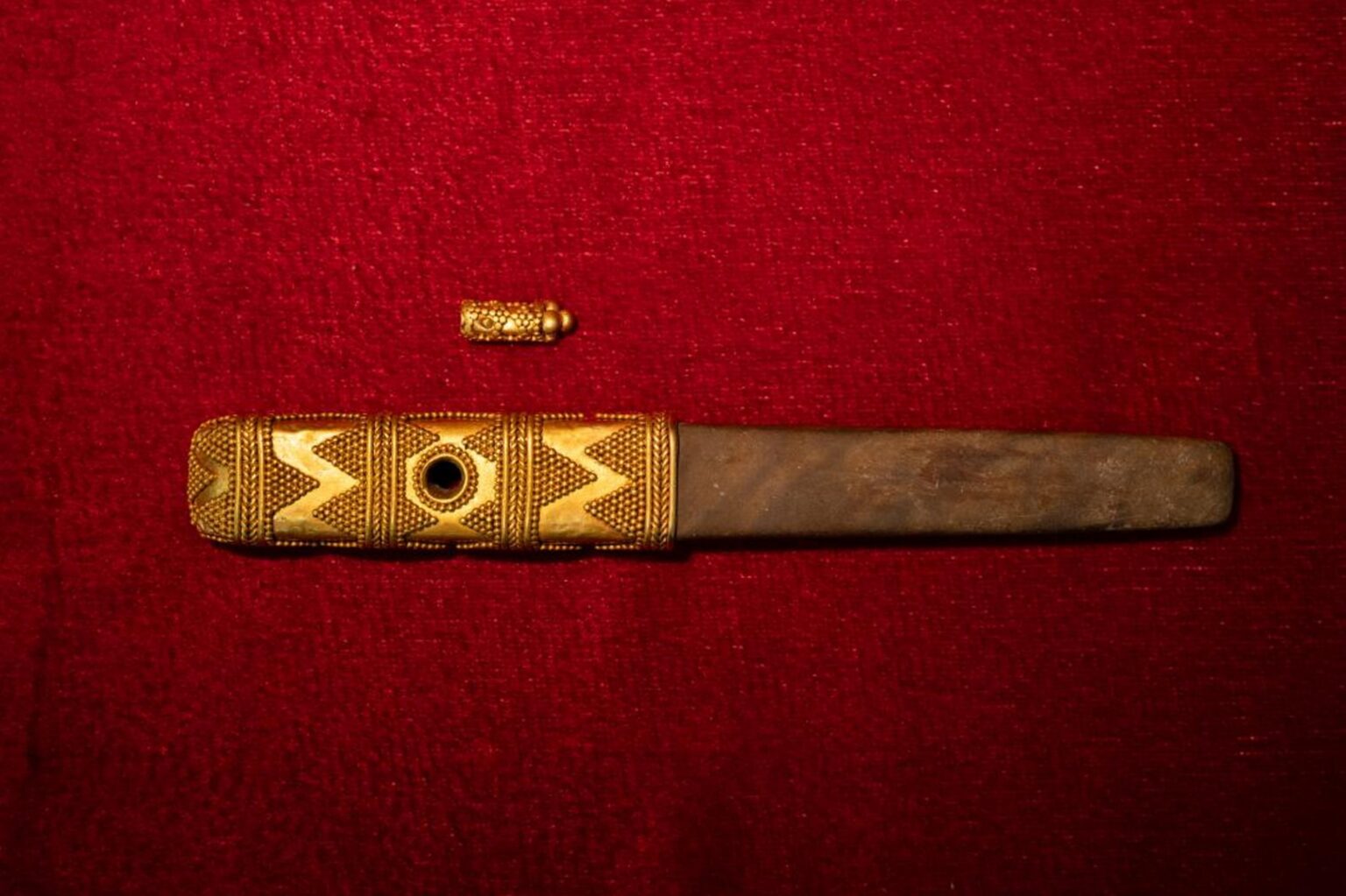
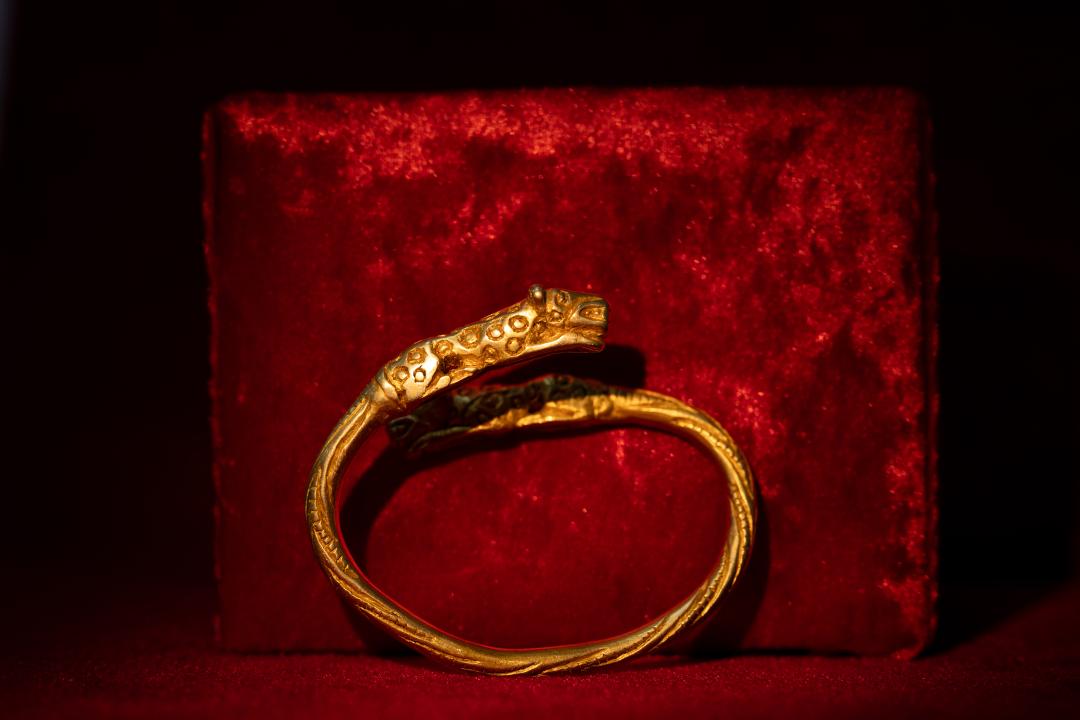
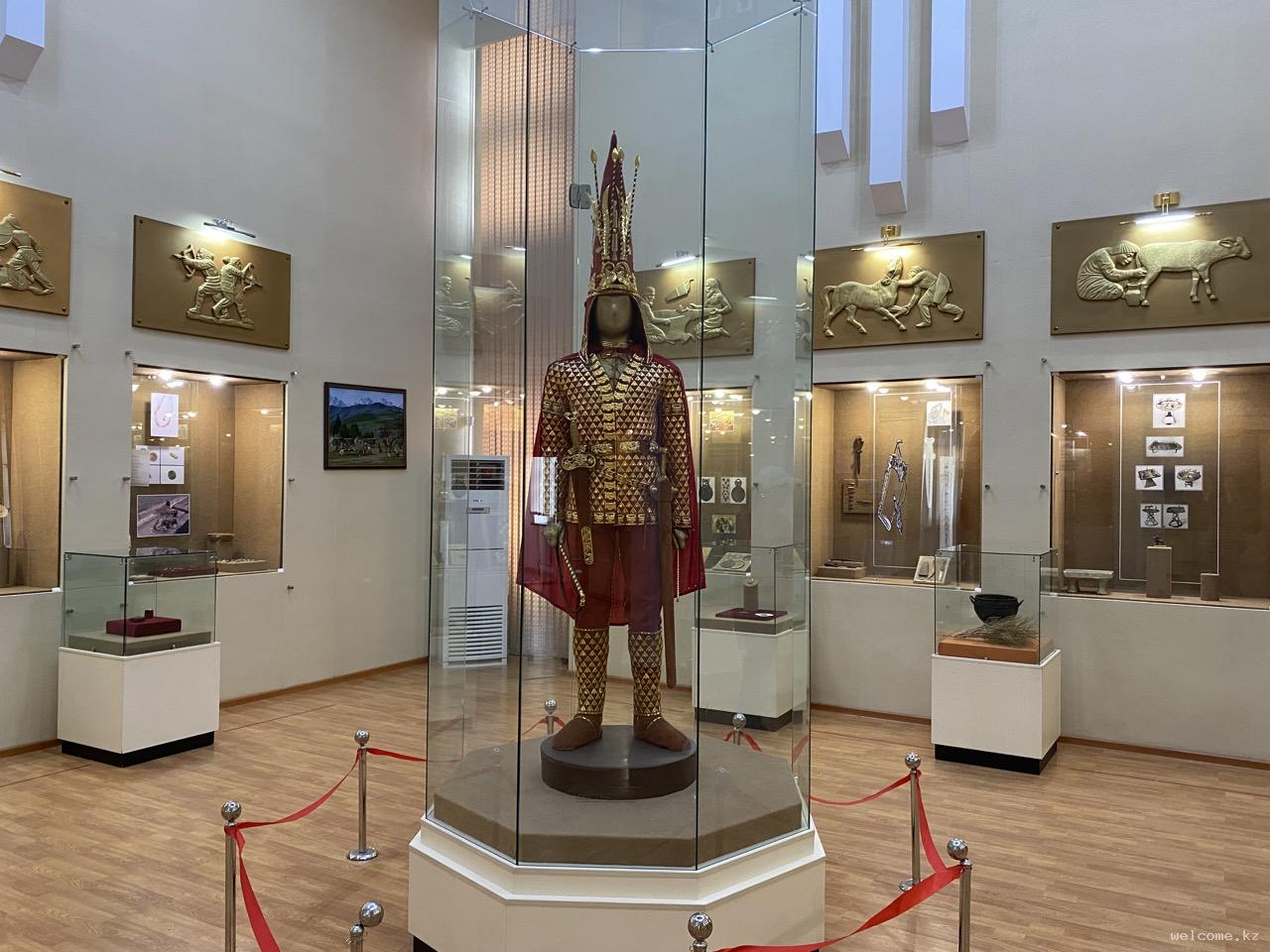
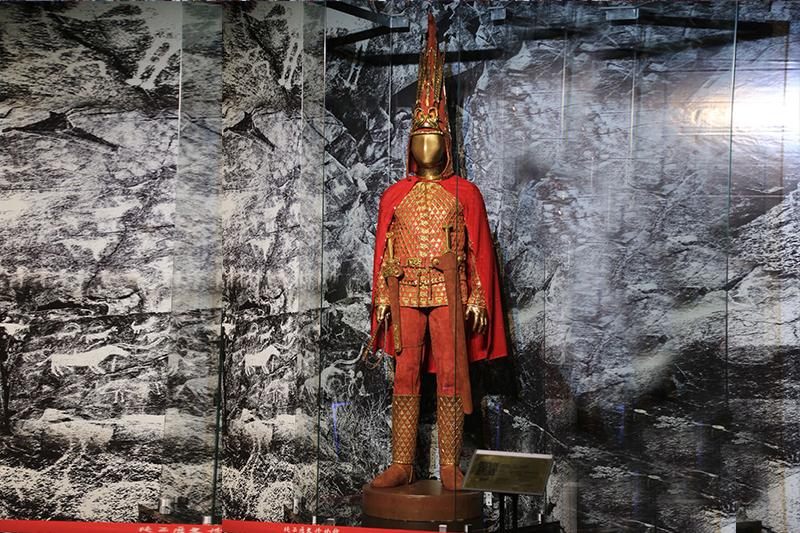
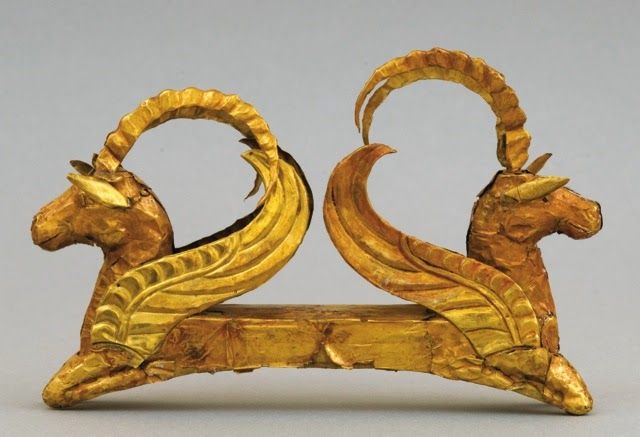
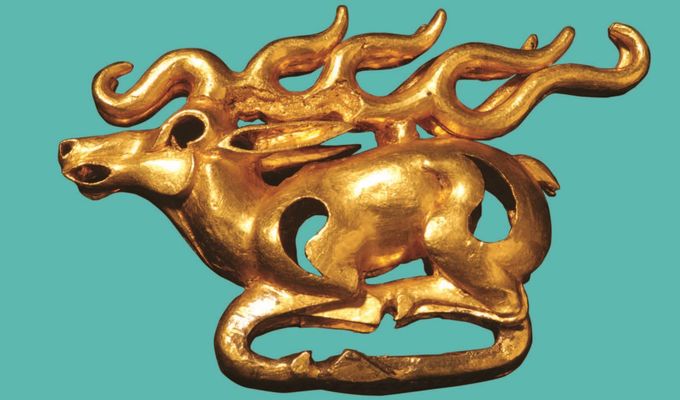
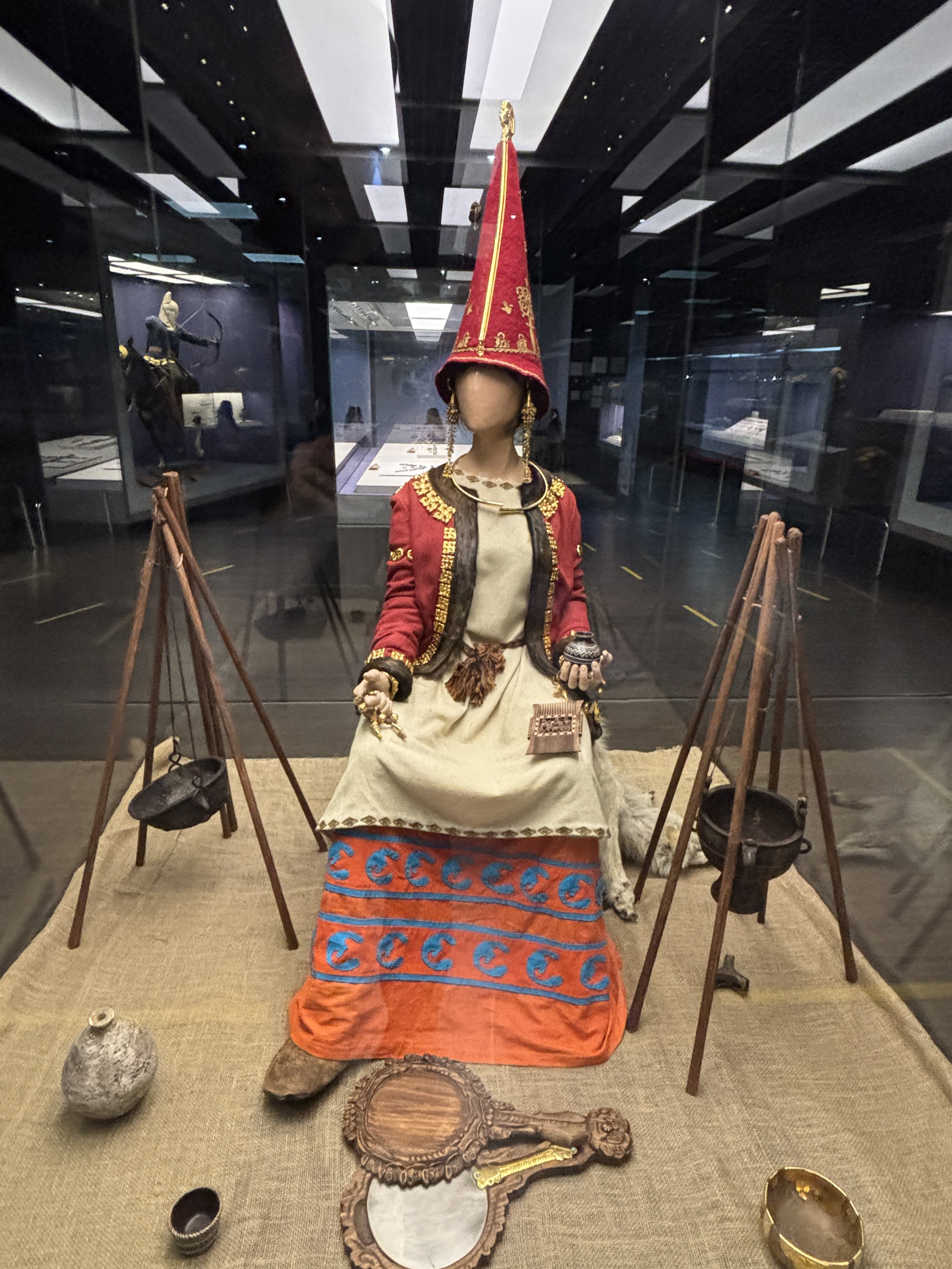
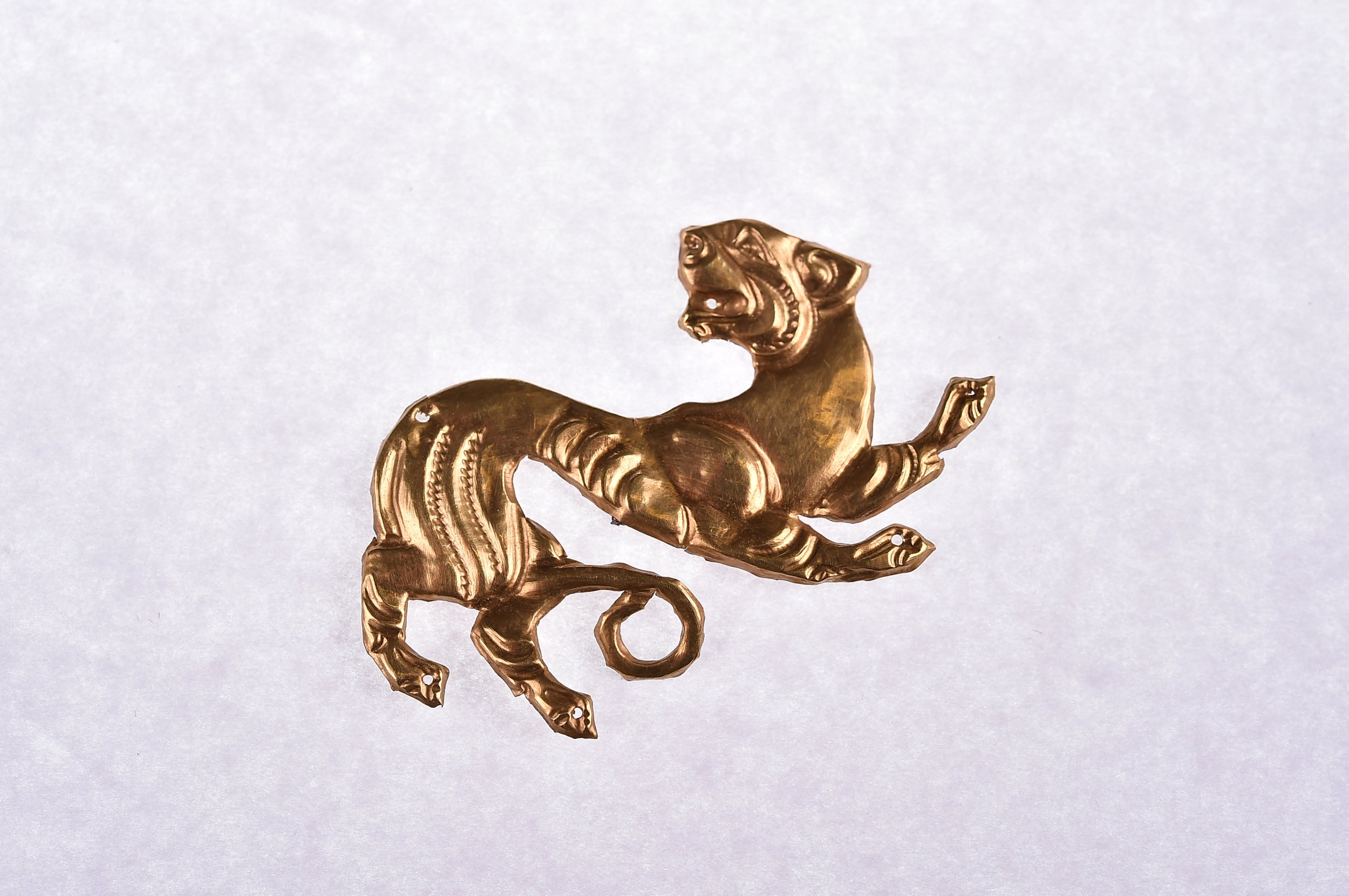
In 1969, archaeologists excavating a burial mound (kurgan) near Issyk, 50 kilometres east of what is now Almaty, broke into a chamber untouched for 2,500 years. Inside lay a young warrior — perhaps a prince, perhaps a high-priest-king — dressed in a suit of more than 4,000 hand-crafted gold plaques, each shaped into animals, griffins, and sacred symbols of the steppe cosmos. The world named him the "Golden Man" (Altyn Adam). He was Kazakh. He was ancient. And today he stands as the national symbol of the Republic of Kazakhstan.
The Saka left no written records — their history lives in the earth itself and in the chronicles of their enemies, who feared and admired them equally. The Persian emperor Darius I called them the "pointed-hat Saka" because of their tall conical headdresses. The Greeks marvelled at their riding skill.
"They shoot from horseback, turning in the saddle to release arrows behind them even as they flee — the retreat itself is an attack." — Herodotus on the Scythian/Saka method of war
Queen Tomyris: The Woman Who Defeated the World's Greatest Conqueror
Among all the figures of the ancient steppe, none stands taller than Tomyris — queen of the Massagetae, a steppe people closely related to the Saka. In 530 BCE, the Persian Emperor Cyrus the Great — the man who had conquered Babylon, Lydia, and the Medes, ruler of the largest empire the world had yet seen — turned his eyes northward.
He sent Tomyris a marriage proposal. She rejected it. He crossed the Araxes River with the greatest army of the ancient world. Tomyris warned him to go back. He did not. The battle that followed — fought on the open steppe — ended in the total annihilation of the Persian force. Cyrus the Great was killed. According to Herodotus, Tomyris plunged his severed head into a skin of blood, declaring: "I warned you. Now drink your fill."
She was the world's first recorded female military commander to defeat a superpower in open battle. She was from the Kazakh steppe.
The Civilisation They Built
The Compound Bow — A revolutionary weapon built from laminated bone, sinew, and wood, it could drive an arrow through armour at 200 metres. The steppe peoples' military dominance for two thousand years rested on this technology.
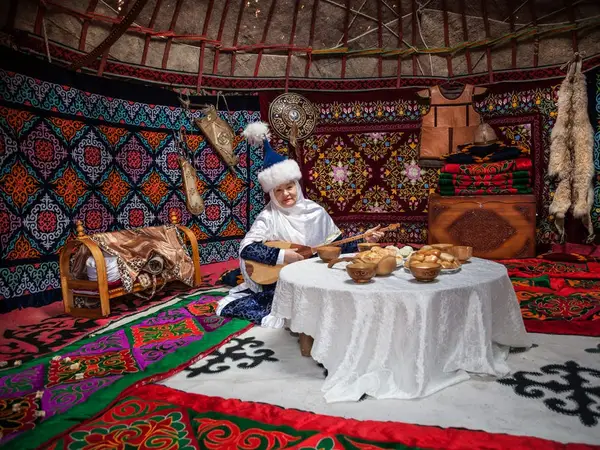
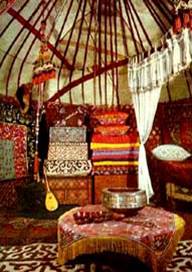
The Yurt (Kiiz Üy) — A circular, collapsible dwelling of felt over a latticed wooden frame that could be assembled in under an hour and withstand steppe blizzards. In −30°C temperatures, the interior stays warm from body heat alone. It is not a primitive tent — it is a masterpiece of engineering refined over millennia, and it remains the symbol of Kazakh identity to this day.
Animal Style Art — Distinctive gold and bronze depictions of animals in dynamic motion — predators striking, deer leaping, griffins locked in combat. This artistic vocabulary spread from the Kazakh steppe across the entire Eurasian world, from Ireland to China.
Qymyz (Fermented Mare's Milk) — The sacred, nourishing drink of the steppe that sustained warriors and travellers across thousands of kilometres of grassland. Still drunk at celebrations across Kazakhstan today.
The people of the ancient steppe are not a prelude to Kazakh history. They are Kazakh history — the deep roots from which everything that followed grew.
The Crossroads of the World: Silk Road & The Golden Horde
In the 7th century CE, Arab geographers began writing of a great crossroads in the heart of Asia where the world's wealth pooled and redistributed. They called the region Mawarannahr and its northern steppe the Desht-i-Kipchak — the Kipchak Steppe. Today we call it Kazakhstan. And for a thousand years, it was the beating heart of the greatest trade network humanity has ever built.
The Silk Road Was a Kazakh Road
The Silk Road was not road. It was a living web of routes, and the most important threads of that web passed directly through the Kazakh steppe. Caravans carrying Chinese silk, Indian spices, Persian glass, Byzantine gold, and Roman coins converged on Kazakh oasis cities that grew fat on transit taxes and skilled craftsmanship.
Otrar (called Farab by medieval Arab scholars) sat at the confluence of the Syr Darya and Arys rivers. It was a walled city of 200,000 people with a famous library, irrigated gardens, and a philosophical tradition so rich that the great medieval scholar al-Farabi (872–950 CE) — considered second to Aristotle in the Islamic world — was born here. Al-Farabi's works on music theory, logic, political philosophy, and the classification of sciences shaped both Islamic and European thought for centuries. He was Kazakh by birth.
Taraz was described by the 10th-century Persian geographer al-Muqaddasi as a prosperous city with thriving markets and a population of diverse faiths — Christians, Zoroastrians, Buddhists, and Muslims living side by side in the cosmopolitan manner that the steppe always encouraged.
Turkistan (then called Yasi) grew around the shrine of the Sufi mystic Khoja Ahmed Yasawi (1093–1166), whose Turkic-language poetry — among the earliest surviving Turkic literature — spread Islam across Central Asia through the power of verse rather than the sword. His message: that the divine was found not in rigid ritual but in the love poured into every act of a human life. The magnificent mausoleum built over his tomb by Timur in the 14th century still stands as of the greatest works of Central Asian architecture, and Turkistan remains of Kazakhstan's most sacred cities.
The Mongol Storm and the Jochi Ulus
In 1218, a Mongol trade caravan of 450 merchants arrived at the Kazakh city of Otrar. The city's governor, Inalchuq Qadir Khan, accused them of spying and executed the entire caravan. It was the most consequential administrative error in Central Asian history.
Genghis Khan's response was the total destruction of the Khwarazmian Empire. By 1221, Otrar had been razed. Its libraries burned. Its population killed. The Mongol conquest was catastrophic in its immediate violence — whole cities were depopulated, irrigation systems destroyed, and trade networks severed for a generation.
Yet from the ashes of conquest emerged something unexpected: the world's largest contiguous empire, and with it, an era of enforced peace known as the Pax Mongolica. Under Mongol rule, the Silk Road reopened with unprecedented security. Merchants, diplomats, missionaries, and scholars could travel from the Pacific to the Black Sea under the protection of a single law code, the Yasa. Marco Polo walked this road. The Moroccan scholar Ibn Battuta walked it too, marvelling at the wealthy Kazakh steppe cities he passed through.
From Genghis Khan's eldest son Jochi, the northwestern portion of the Mongol empire — the lands of the Kazakh steppe — became the Jochi Ulus, which the world later called the Golden Horde. Here, on the steppe that had always been Kipchak Turkic territory, the Mongol ruling class gradually absorbed the far more numerous Turkic population, adopting their language, their customs, and eventually their faith.
Islam Comes to the Steppe
Khan Özbek (1313–1341) formally made Islam the religion of the Golden Horde — but the Islam that took root on the Kazakh steppe was a deeply Sufi-inflected, tolerant, culturally syncretic form. It did not erase the ancient traditions of the steppe. It merged with them. The veneration of ancestors continued; the oral epic tradition continued; the nomadic lifestyle continued. Islam became Kazakh, and Kazakhs made Islam their own.
Khan Özbek's reign marked the zenith of Golden Horde power. His capital, Sarai Berke on the Volga, was a metropolis of 600,000 people — of the largest cities in the medieval world — with a mint, a postal system, palaces of marble and brick, and streets so wide that ten horsemen could ride abreast.
The legacy of the Golden Horde was immense: it carried Islam deep into the steppe, established diplomatic links between East and West, and created administrative frameworks that would endure for centuries. When the Horde fragmented in the mid-15th century, the political vacuum it left behind set the stage for the birth of something entirely new: the Kazakh nation.
"I saw in this steppe a city of great beauty, with markets full of goods from every country, and people of a hundred languages passing through its gates." — Ibn Battuta, describing a city of the Golden Horde, 14th century
1465: The Birth of the Kazakh Nation
The year is 1465. Two princes — Kerey Khan and Janibek Khan — have led a bold migration of clans away from the fractious politics of the Abulkhair Khanate and into the fertile lands near the Chu and Talas rivers in what is now southeastern Kazakhstan. They call their people Qazaq — a Turkic word carrying the meaning of free spirit, adventurer, one who has broken away.
This act of exodus — this choosing of freedom over the security of an established but corrupt order — is considered the founding moment of the Kazakh Khanate, the first state to bear the name Kazakh. It was not born of conquest. It was born of choice.
The Structure of a Nation: The Three Zhuzes
The Kazakhs organised themselves into three great Zhuzes (federations), each with its own territory, lineages, and military responsibility:
The Senior Zhuz (Uly Zhuz) — occupied the fertile Semirechye region (Seven Rivers country) in the southeast, homeland of clans including the Dulat, Jalair, and Albans. The Senior Zhuz produced many of the great khans and controlled the most productive agricultural land.
The Middle Zhuz (Orta Zhuz) — the largest in territory, spanning the central steppe. Home of clans including the Argyns, Kipchaks, Naymans, and Kereits — descendants of peoples who had lived on the central steppe since before recorded history. The Middle Zhuz was the intellectual heartland, home of most of the great zhyraus (bardic poets) and biys (judges).
The Junior Zhuz (Kishi Zhuz) — the western federation, occupying the lands between the Ural and Emba rivers. The most westerly and therefore the first to encounter the expanding Russian Empire in the 18th century.
This was not tribal fragmentation — it was a sophisticated federal system designed for managing a nomadic civilisation across an enormous territory. The three Zhuzes united under a single Great Khan in times of existential threat, and managed their affairs autonomously in times of peace.
Kasym Khan: The Golden Age
Under Kasym Khan (r. 1511–1521), the Kazakh Khanate reached its first great zenith. From his base near the Syr Darya river, Kasym commanded a confederation of over one million subjects — the largest Kazakh polity yet assembled — and controlled trade routes stretching from the Volga to the Syr Darya. He established the first Kazakh legal code, the Qasym Khannyn Qasqa Zholy ("Kasym Khan's Straight Path"), governing inheritance, blood feuds, trade disputes, and clan relations. He conducted diplomacy with the Moscow Principality — the first Kazakh-Russian diplomatic contact in history. Kazakh oral tradition remembers his reign simply as the Golden Age.
The Great Khans: Builders of the Nation
Haqnazar Khan (r. 1538–1580) — A master of steppe diplomacy who expanded Kazakh territory and maintained independence during of its most vulnerable periods, forging strategic marriages across the steppe world and fighting successfully against the Shaybanid Uzbeks and Siberian Khanate on multiple fronts simultaneously.
Esim Khan (r. 1598–1628) — The consolidator. After decades of internal conflict, Esim reunified the khanate and defeated Bukhara's attempts to expand northward. He updated Kasym Khan's legal code in the Esim Khan's Ancient Road, a legal revision that remained foundational to Kazakh customary law for generations.
Jangir Khan (r. 1629–1652) — Also called Salqam Jangir ("the Stern"). At the Battle of Orbulak (1643), Jangir Khan famously held off a Dzungar force of 50,000 warriors with just 600 fighters using an improvised fortification — a tactical feat that echoed through Kazakh military memory for centuries and is studied to this day.
Tauke Khan (r. 1680–1718) — The lawgiver. Tauke Khan created the Jeti Jargy ("Seven Statutes"), the most sophisticated legal code in Kazakh history, drafted in collaboration with the three great biys — the supreme judges of each Zhuz:
Töle Bi of the Senior Zhuz — legendary jurist whose wisdom proverbs are still quoted in Kazakhstan today: "Unity is our strength; division is our grave."
Kazybek Bi of the Middle Zhuz — the diplomat, said to have talked a Dzungar army out of attacking through sheer rhetorical brilliance: "We Kazakhs are neither few nor cowardly — but we prefer words that build over swords that destroy."
Äiteke Bi of the Junior Zhuz — the orator and peacemaker, master of the Kazakh tradition of sheshendik (the art of oratory)
Under Tauke Khan and these three great jurists, the three Zhuzes were more united than at any time since Kasym Khan — just in time for the greatest catastrophe in Kazakh history to arrive.
"The Kazakh is like the eagle — he soars alone, but when the storm comes, all eagles fly together." — attributed to Tauke Khan
The Great Calamity: Survival at the Edge
There is a phrase in Kazakh that carries the weight of an entire civilisation's grief: Aktaban Shubyryndy — "the bare-footed flight". It describes the years 1723 to 1727, when the Dzungar Khanate launched a series of coordinated offensives of such ferocity that the Kazakh people were driven from their ancestral pastures, their animals slaughtered, their cities and trading posts burned. People fled barefoot across the snow. Whole clans perished. The oral tradition records that the steppe was silent where there had been the sound of horses and music and children.
Historians estimate that between one-third and-half of the entire Kazakh population died in this catastrophe — through violence, starvation, exposure, and disease. It is called Zhounghar shapkynshylygy — the Dzungar Invasion — and it is the closest the Kazakh people have ever come to extinction.
The Dzungars: Who They Were and Why They Came
The Dzungars (Oirat Mongols) had built a formidable state in western Mongolia and the Tianshan range. Under their great leaders, they modernised their military with Russian muskets and Chinese artillery, creating a hybrid nomadic-sedentary war machine of unprecedented effectiveness. Their expansion westward was driven by classic steppe geopolitics: the Qing Dynasty was pressing them from the east, so they struck west — into Kazakh territory — to find the space they needed. The Kazakhs were in the way of a desperate empire.
The Rise of the Batyrs: Warriors of the Steppe
Out of the catastrophe rose the figures that Kazakhs still venerate as national heroes — the batyrs (warriors). These were not feudal knights fighting for a lord. They were champions who fought for a people, charismatic commanders who inspired men through the sheer force of their courage and personality.
Kabanbay Batyr (1692–1770) — Born in the Middle Zhuz, Kabanbay became the supreme military commander of the Kazakh resistance. A master of guerrilla tactics, he understood that the Kazakhs could not defeat the Dzungars in set-piece battles, so he attacked supply lines, harassed flanks, and never gave the enemy a target to destroy. He led the decisive forces at Anrakay. He is remembered across Kazakhstan as Er Kabanbay — Kabanbay the Hero.
Bogenbay Batyr (1680–1775) — Called Temirqol ("Iron Arm") for the crushing strength of his sword arm, Bogenbay commanded the right wing of the united Kazakh armies. He lived to nearly 100, surviving the entire arc of the Dzungar conflict, and his longevity in battle became legendary. Warriors said he was protected by the ancestors.
Nauryzbay Batyr — The hero of the Senior Zhuz, instrumental in the victory at Anrakay. His name is preserved in the city of Nauryzbaybatyr (now Talgar), near Almaty.
Raiymbek Batyr (c. 1704–1785) — Protector of Semirechye (the Seven Rivers region). When Dzungars occupied the Ili River valley, Raiymbek organised the resistance that eventually expelled them. A towering bronze statue of him overlooks modern Almaty. He is the guardian spirit of the city.
Shanyraq Batyr, Malaisary Batyr, Oljaybay Batyr — Dozens more batyrs fought alongside these giants. The Kazakh tradition honours them all by name, preserving their deeds in the great oral epics.
The Battle of Bulanty (1726): First Blood
After three years of flight and catastrophe, the Kazakhs made their first organised stand. At the Battle of Bulanty (also called Qalmaqtyrghan — "the place where the Kalmyks were destroyed"), a combined Kazakh force from all three Zhuzes ambushed a Dzungar column in the rocky passes of the Ulytau mountains of central Kazakhstan. The victory was partial but its psychological effect was total: the Kazakhs could fight back. The place was renamed and the news spread across the steppe, drawing more warriors to the cause.
The Battle of Anrakay (1729): The Turn of the Tide
The decisive engagement of the Dzungar Wars took place near Lake Alakol in what is now southeastern Kazakhstan. A united Kazakh army of up to 70,000 warriors from all three Zhuzes faced the Dzungar host in a battle that lasted three days.
At a crucial moment, a young warrior of the Middle Zhuz named Äbilmansur — later to be known as Ablai Khan — personally challenged and killed the Dzungar champion Sharish in single combat before the assembled armies. The Kazakh warriors, electrified by the act, fought with renewed ferocity. The Dzungars were routed.
Ablai Khan: The Greatest Statesman of the Steppe
The young hero of Anrakay went on to become Ablai Khan (1711–1781), of the most gifted political minds of the 18th-century Eurasian world. Ablai understood something many steppe rulers before him had not: that the age of purely nomadic power was ending. Two great sedentary empires now pressed Kazakhstan from north and east — Russia and China — and neither could be defeated militarily. They could be managed diplomatically.
Ablai managed them with extraordinary skill for five decades. He negotiated simultaneously with the Russian Empire, the Qing Dynasty, and the Central Asian khanates, extracting concessions from each while surrendering sovereignty to none. He played power against another with a finesse that modern diplomatic historians have compared to Bismarck and Metternich. When the Qing finally annihilated the Dzungar people in 1757–1758 — a genocide in which 600,000 people were systematically killed — Ablai Khan had already positioned Kazakhstan to benefit from the resulting power vacuum rather than be absorbed by it.
In 1771, Ablai Khan was formally recognised as Khan of all three Zhuzes — the last ruler to hold this title. He died in 1781, knowing that the world his ancestors had built was changing faster than any single ruler could control.
"We do not fight for glory. We fight for the grass, for the sky, for the children who will ride these plains when we are gone." — Attributed to Ablai Khan
The Imperial Shadow: Colonization & Resistance
The Russian Empire did not conquer Kazakhstan in a single campaign. It did not win a decisive battle and plant a flag. Instead, it advanced like a slow tide — methodical, patient, and relentless — across six generations, using fortresses, treaties, bureaucracy, and the calculated exploitation of Kazakh political divisions to absorb the largest nomadic state in the world.
The Fortress Strategy: Strangling the Steppe
Beginning in the 1730s, Russia began building a chain of fortresses along the northern and western edges of the Kazakh steppe — Orenburg (1735), Orsk (1735), Troitsk (1743), and dozens more. These were not just military posts. They were economic strangleholds. The forts cut off traditional migration routes, forced Kazakh clans to settle in their shadows, and funnelled trade through Russian-controlled markets.
The Orenburg Frontier Line to the west and the Siberian Line to the north formed a closing pincer. By 1800, most of the Junior Zhuz was under nominal Russian suzerainty. By 1820, the Middle Zhuz had been incorporated. By 1848, with the fall of the last independent Khan, the conquest was functionally complete — though resistance continued for decades more.
The consequences were devastating. The loss of seasonal migration routes meant loss of access to summer and winter pastures that had sustained the nomadic economy for millennia. Herds shrank. Families went hungry. The intricate ecological knowledge of the steppe — which grasses to graze in which season, which routes to take, which waterholes to use — became worthless when the routes were blocked.
The Last Khans and the First Resisters
Abulkhair Khan of the Junior Zhuz (r. 1718–1748) made the decision that still divides Kazakh historians: in 1731, exhausted by Dzungar attacks and internal division, he formally submitted to Russian suzerainty, seeking Russian military backing. Russia accepted — and then used the relationship to extend control far beyond anything Abulkhair had agreed to. His political gamble cost the Junior Zhuz its independence within a generation.
Syrym Datuly (1753–1802) — the first great rebel — led an uprising from 1783 to 1797 that shook Russian control of the western steppe. His cause was straightforward: the return of stolen pastures, the removal of corrupt Russian administrators, and the restoration of Kazakh customary law. He fought the Russian military to a standstill for fourteen years. When the uprising was finally suppressed, Syrym Datuly fled to Khiva, where he died in exile. He was never captured.
Isatay Taymanuly (1791–1838) and Makhambet Otemisuly (1803–1846) — warrior and poet, sword and word. These two men led the 1836–1838 uprising of the Junior Zhuz against exploitative rule. Makhambet Otemisuly was of the greatest poets in Kazakh literature — his battle hymns, composed on horseback before charges, are still read in Kazakh schools today. Isatay was killed in battle at Akyrbai in 1838. Makhambet survived another eight years, continuing to write searing poetry about resistance and loss, before being assassinated in 1846.
"I am not afraid of the sword that kills the body. I fear the silence that kills the soul." — Makhambet Otemisuly
Kenesary Kasymov (1802–1847) — The Last Khan. Grandson of Ablai Khan, Kenesary spent a decade (1837–1847) leading the most comprehensive uprising against Russian rule Kazakhstan had ever seen. He reunited warriors from all three Zhuzes, established a functioning government with its own tax system, judicial apparatus, and diplomatic correspondence — he wrote directly to the Tsar demanding recognition of Kazakh sovereignty — and fought the Russian Imperial Army to an effective standstill across hundreds of kilometres of steppe. The Russians never defeated Kenesary in the field. He was eventually betrayed by Kyrgyz tribal leaders and killed in 1847. His head was sent to Omsk as a trophy. The Kazakh khanate system was formally abolished. But his name became a rallying cry for every generation of Kazakhs that followed.
The Settlement Wave and the 1916 Uprising
From the 1860s, the Russian Empire actively colonised Kazakhstan with Slavic settlers given land grants on what was legally declared "empty" steppe. This land was not empty. It was the seasonal pasture of Kazakh nomads, the graveyards of their ancestors, the ranges their clans had grazed for centuries. By 1916, over 1.5 million settlers had been allocated Kazakh land. The nomadic economy was pushed toward collapse.
Then came 1916. As World War I consumed Russia's manpower, the Tsar issued a decree conscripting Central Asians — including Kazakhs — for rear-echelon labour. The response was immediate: the Uprising of 1916, in which Kazakh, Kyrgyz, and Uzbek populations rose across Central Asia. The repression was brutal. Estimates suggest 100,000 to 270,000 Kazakhs and Kyrgyz were killed, with hundreds of thousands more fleeing to China.
The Alash Orda: Kazakhstan's First Democratic State
Out of this crucible emerged a generation of extraordinary intellectuals who would try to build a different future — not with weapons, but with ideas.
In the chaos of the 1917 Russian Revolution, under the leadership of Alihan Bukeikhanov (1866–1937) — a prince of the Chingizid lineage, trained statistician, journalist, and political organiser — the Alash Orda party was founded and in December 1917 declared the Alash Autonomy: the first Kazakh state with a modern governmental structure.
The architects of Alash were remarkable individuals:
Akhmet Baitursynov (1873–1937) — linguist, educator, and poet. He reformed the Kazakh alphabet to better suit Kazakh phonology and founded the first Kazakh-language newspaper Qazaq. He is considered the father of modern Kazakh linguistics. Executed by Stalin in 1937.
Mirzhakyp Dulatov (1885–1935) — journalist, poet, and novelist. His 1910 novel Oyan, Qazaq! ("Awake, Kazakh!") was the first Kazakh-language novel and a call to political consciousness. Died in a labour camp in 1935.
Halel Dosmukhamedov (1883–1939) and Zhakhan Dosmukhamedov — doctors and administrators who organised health and education systems for the new autonomy. Both were later shot.
The Alash Orda negotiated with both the White Army and the Bolsheviks, trying to find any arrangement that would preserve Kazakh autonomy. By 1920, the Bolsheviks had won the Civil War and dissolved the Alash Autonomy by force. Most Alash leaders cooperated with the new Soviet state, believing they could still protect Kazakh culture from within. They were tragically wrong. Almost all were arrested in the 1930s and shot as "enemies of the people" during Stalin's Great Purge.
Kazakhstan had its first democratic government. It lasted two years. Its creators were murdered. But their ideas — of a Kazakh nation with its own language, law, and self-determination — could not be killed.
The Soviet Crucible: Tragedy and Transformation
The Soviet era is the most contested chapter of Kazakh history — and the most important to understand free from the distortions of Soviet-era propaganda. It was a period of catastrophic suffering and genuine material development, of cultural devastation and cultural survival, of crimes against humanity and extraordinary individual heroism. To understand modern Kazakhstan, you must understand what happened between 1920 and 1991.
The Asharshylyk: The Hunger That Almost Finished What the Dzungars Could Not
In 1928, Soviet authorities began the forced collectivisation of Kazakh nomads — a policy that, in practice, meant the destruction of the nomadic economy. Cattle, horses, sheep, and camels — the entire material basis of Kazakh civilisation — were seized by the state and herded into collective farms with no understanding of how to manage them. Millions of animals died. The nomadic knowledge system that had sustainably managed the steppe ecosystem for 5,000 years was dismantled in five years.
What followed was the Asharshylyk ("the Great Hunger"), the Kazakh famine of 1930–1933. Estimates by Kazakh and Western historians indicate that between 1.5 and 2.3 million Kazakhs died — 38 to 42 percent of the entire Kazakh ethnic population. Of the approximately 4 million livestock that sustained the nomadic economy, over 90% perished.
Entire extended families, entire clans, entire regional populations were exterminated by famine. Nearly 600,000 fled to China, Mongolia, and Afghanistan — a diaspora that still exists today, with large Kazakh communities in China's Xinjiang region tracing their origins to this flight. The Asharshylyk was not an accident: Soviet policy documents accessible since the 1990s reveal that officials knew the scale of the famine and did not act to prevent it. Kazakhstan's experience was analogous to the Ukrainian Holodomor — a state-administered famine that decimated a specific national population. Kazakh historians increasingly describe it as genocide.
The consequences extended beyond the death toll: Kazakhstan, after 1933, became a majority-Russian republic for the first time in its history. The Kazakh people would not reclaim majority status in their own land until after 1991.
The Enlighteners Who Kept the Flame Alive
Shokan Walikhanov (1835–1865) — The father of Kazakh scholarship. The great-grandson of Ablai Khan, educated at the Russian Imperial Military Academy, he became the first Kazakh ethnographer, cartographer, and historian. His meticulous records of Kazakh oral literature, customs, genealogies, and Central Asian geography are invaluable primary sources. He died of tuberculosis at 29, leaving behind scholarship that modern Kazakhstan still builds upon.
Ybyrai Altynsarin (1841–1889) — The father of Kazakh education. He opened the first secular schools for Kazakh children — including schools for girls, a revolutionary act for the time — created the first Kazakh-Russian textbooks, and fought simultaneously against Russian paternalism and conservative opposition to girls' education. His motto: "Knowledge is the path from darkness to light."
Abai Kunanbaiuly (1845–1904) — The greatest poet in Kazakh literary history. Born in the Chingiz mountains of Eastern Kazakhstan, Abai studied Persian, Arabic, and Russian alongside the Kazakh oral tradition. His masterwork, the Qara Sozder ("Book of Words"), combined the philosophical depth of the Sufi tradition with searing social criticism and an impassioned argument for education, self-improvement, and human dignity. He translated Pushkin and Lermontov into Kazakh with such beauty that Kazakhs still recite them. His statue stands in virtually every Kazakh city. He is not a historical figure — he is a living presence.
Kazakhstan Goes to War: Heroes of 1941–1945
When Nazi Germany invaded the Soviet Union in June 1941, Kazakhstan was transformed. Factories were evacuated from western Russia and rebuilt on the Kazakh steppe. The republic sent 1.2 million soldiers to the front — a staggering number for a population of just over 6 million. Approximately 600,000 did not return.
Bauyrzhan Momyshuly (1910–1982) — The greatest Kazakh military figure of the 20th century. A colonel who commanded the desperate defence of Moscow in October 1941, Momyshuly developed the "spiral" tactic — a method of small-unit defensive manoeuvre that bled German armoured columns without exposing infantry to annihilation. His memoir became a standard text in military academies across the world. He refused to let his men die uselessly. He is remembered as a tactician of genius and a man of iron integrity.
Aliya Moldagulova (1925–1944) — A sniper with the 54th Rifle Brigade. Orphaned as a child and raised in a Leningrad orphanage, she became of the most effective snipers in the Soviet military with 91 confirmed kills. She died at 18, leading a bayonet charge after her unit was pinned down. Posthumously awarded Hero of the Soviet Union. Asteroid 3122 Aliya bears her name.
Manshuk Mametova (1922–1943) — A machine gunner who held her position alone during the Battle of Nevel, continuing to fire to cover her comrades' retreat even after being mortally wounded. She was the first Kazakh woman to receive Hero of the Soviet Union. She was 21 years old.
Rakhimzhan Qoshkarbayev (1924–1988) — of the soldiers who raised the flag over the Reichstag in Berlin on April 30, 1945 — hours before the famous photograph. His contribution was long suppressed because he was Kazakh, not Russian. Post-Soviet historians have restored him to his rightful place in history.
Sagadat Nurmagambetov (1924–2013) — Tank commander who survived the entire war and became the first Minister of Defence of independent Kazakhstan in 1992. The embodiment of Kazakhstan's journey from war to sovereignty.
The Steppe as Laboratory: Space and Nuclear Tests
The Baikonur Cosmodrome — built in 1955 on the Kazakh steppe — became the launch site from which Sputnik (1957) and Yuri Gagarin (1961) began the Space Age. The first human to leave the Earth's atmosphere launched from Kazakh soil. This is a source of genuine Kazakh pride — though Kazakhstan never controlled the facility, built and operated entirely by Moscow. The cosmodrome continues operating today under a lease with Russia, while Kazakhstan develops its own Baiterek launch complex.
The Semipalatinsk Nuclear Test Site — the Polygon — was established in 1949 on 18,500 square kilometres of Kazakh steppe. Between 1949 and 1989, 456 nuclear tests were conducted here — 116 above ground, 340 underground. The Soviet government did not inform the surrounding population. Studies found dramatically elevated rates of cancer, birth defects, and genetic abnormalities among the approximately 1.5 million people exposed to radiation over four decades.
The poet and scholar Olzhas Suleimenov (born 1936) founded the Nevada-Semipalatinsk anti-nuclear movement in 1989, mobilising hundreds of thousands of Kazakhs in protests that eventually forced Moscow to halt testing. The Semipalatinsk site was officially closed in August 1991. Kazakhstan now observes August 29 as the International Day Against Nuclear Tests — recognised by the UN in 2009.
Jeltoqsan 1986: The Revolution That Started with Students
On December 17, 1986, Soviet leader Mikhail Gorbachev appointed a Russian engineer, Gennady Kolbin — who had never lived in Kazakhstan and did not speak Kazakh — as First Secretary of the Kazakh Communist Party. The next morning, students from Almaty's universities began gathering in Republic Square. By December 18, several thousand young people were demanding Kazakh leadership of Kazakhstan.
Gorbachev's response was OMON riot troops with batons, sapper shovels, and military dogs. The uprising — known as Jeltoqsan ("December") — was crushed with considerable violence. Hundreds were arrested, tortured, or expelled from university. Kayrat Ryskulbekov — a student arrested in the aftermath — was sentenced to death on fabricated murder charges and executed in 1988 at age 21. He became the martyr of the movement.
Jeltoqsan was the seed. Five years later, it flowered into independence. The generation that marched in December 1986 was the generation that built the new Kazakhstan.
1991: A New Horizon
On December 16, 1991, the Supreme Soviet of the Kazakh Soviet Socialist Republic voted to declare the independence of the Republic of Kazakhstan. It was the last of the Soviet republics to do so — not from hesitation, but from political calculation. President Nursultan Nazarbayev had spent months trying to preserve a reformed union that would give Kazakhstan autonomy without full separation. When the USSR collapsed anyway, Kazakhstan was ready.
The republic that emerged faced challenges that would have broken lesser nations. It had inherited the fourth-largest nuclear arsenal in the world — 1,410 strategic nuclear warheads left behind by the Soviet military. It had an economy built to serve Soviet industrial needs, not Kazakh. It had a population in which ethnic Kazakhs were a bare majority, after decades of Russian settlement and the demographic catastrophe of the Asharshylyk. It faced environmental devastation at Semipalatinsk and the Aral Sea — drained to irrigate Soviet cotton fields, shrinking to 10% of its original size. It had no diplomatic infrastructure, no foreign currency reserves, and no experience of independent governance.
What it had was an ancient civilisation's worth of resilience, and a people who had been waiting, through conquest and famine and repression, for exactly this moment.
The Nuclear Decision: A Gift to the World
In 1992–1994, Kazakhstan transferred all its nuclear weapons to Russia and signed the Nuclear Non-Proliferation Treaty. This was a sovereign choice — made in exchange for security guarantees from Russia, the United States, and the United Kingdom under the Budapest Memorandum (1994). Kazakhstan was, at the time of independence, the country in history to have voluntarily renounced nuclear weapons it physically possessed and controlled.
This act elevated Kazakhstan's international standing enormously. The Semipalatinsk test site was officially closed in 1991. In 2006, Kazakhstan completed the physical destruction of the Polygon's tunnels and infrastructure. Today, Kazakhstan hosts the IAEA Low Enriched Uranium Bank on its territory — a global nuclear fuel reserve designed to prevent nuclear proliferation — and is of the world's most credible voices for disarmament.
Building a Capital from Steppe and Sky
In 1997, President Nazarbayev announced that Kazakhstan would move its capital from Almaty to a small city called Akmola on the northern steppe. Critics called it madness — the winters are brutal, the infrastructure minimal, the cost enormous.
Twenty-five years later, Astana is of the most architecturally extraordinary cities on earth. Norman Foster designed the Khan Shatyr — the world's largest tent, 150 metres tall, containing a beach resort under its transparent membrane in the middle of a steppe winter. The Baiterek tower — a 97-metre monument representing the mythical world-tree of Kazakh cosmology — has become the city's symbol. A futuristic skyline rises from flat grassland like a vision of the 22nd century.
Astana is also, unmistakably, a statement: we are here, we are permanent, we are building.
The Cultural Renaissance: Ancient Traditions, New Voices
Independence unleashed a cultural energy that the Soviet period had suppressed for seven decades. The Kazakh language, marginalised in favour of Russian throughout the Soviet era, began a long recovery. Kazakh literature, music, and film found new audiences. The ancient oral epic tradition — the zhyrau poets, the dombra players, the Nauryz spring celebrations that had been banned as "backward" — returned to public life with powerful emotion.
Dimash Kudaibergen (born 1994) — A singer from Aktobe whose extraordinary six-octave vocal range and mastery of opera, traditional Kazakh music, and contemporary pop made him of the most-watched performers on the internet in the 2010s, with passionate fan clubs ("Dears") from China to Brazil to Argentina. For much of the world, Dimash was the first Kazakh person they had ever heard of. He became a-man cultural ambassador for a nation that had been invisible.
The dombyra — the two-stringed Kazakh lute played by zhyraus for a thousand years, the instrument that has accompanied every Kazakh wedding and funeral and eve of battle — was designated an UNESCO Intangible Cultural Heritage. It remains the most emotionally resonant symbol of Kazakh identity, the sound that makes Kazakhs around the world feel at home.
Kazakhstan Today: A Nation at the Centre of the World
Kazakhstan is the world's ninth-largest country by area — larger than Western Europe combined. It sits at the intersection of the Chinese Belt and Road Initiative, Russian geopolitical interests, and the Central Asian energy market. It is the world's largest producer of uranium. It exports oil, wheat, metals, and increasingly, intellectual capital.
The apple — perhaps the most universal of fruits — originated in the wild forests of the Tian Shan mountains near Almaty. The wild ancestor of every apple on every table in the world, Malus sieversii, still grows in the Ili River valley. The Kazakh word for apple, alma, gave Almaty its name: the City of Apples.
The Kazakh tradition of tracing's lineage through seven generations (Zheti Ata) — knowing not just your parents and grandparents but your great-great-great-great grandparents, their names, their clans, and their deeds — keeps the past alive in the present in a way that no monument or textbook can match. In Kazakhstan, history is not something you study. It is something you carry.
The free spirit (qazaq) who left Abulkhair's khanate in 1465 in search of open steppe and self-determination is not a figure of the past. He lives in every Kazakh who chooses their own path, every artist who reclaims an ancient tradition in a modern form, every student who fights for the right to be themselves on their own land.
The epic of the Great Steppe is not over. It has never been over. It is being written right now.
Key Facts
- Timeline
- 3500 BCE – Present
- Key Empires
- Saka, Huns, Golden Horde
- Nation Founded
- 1465 (Kazakh Khanate)
- Independence
- 1991
- Legacy
- Domestication of the Horse
- Capital
- Astana
- Official language
- Kazakh
- Spaceport
- Baikonur Cosmodrome (world's first)
- First human spaceflight
- Yuri Gagarin (1961) from Baikonur
- Land Area
- 9th largest country in the world
- Origin of Apples
- Almaty Region (Malus sieversii)
- 7 Ancestors Tradition
- Kazakhs trace lineage through 7 generations (7 ata)
- Purpose of 7 Ancestors
- Ensures genetic diversity and prevents inbreeding in marriages
- Marriage Requirement
- Couples must verify they share no common ancestors within 7 generations
- Health Benefits
- Reduces risk of genetic disorders and ensures healthier offspring
- Cultural Significance
- Preserves family honor and maintains strong clan identity
- Historical Practice
- Ancient tradition passed down through oral history and genealogical records
- Modern Application
- Still practiced today, especially in traditional Kazakh communities
Journey Through History
Journey Through Kazakhstan
Location on Map
Loading map...Loading map...
Frequently Asked Questions
Have a question?
Ask and get answers in seconds!
Discussion 0
No comments yet. Start the conversation!
Leave a Reply