Historical Significance
The Unfinished Saint
Nobody warns you about the silence. You expect noise at a pilgrimage site — prayer, at least — but the courtyard of the Mausoleum of Khoja Ahmed Yasawi in Turkestan holds a different quality of quiet. It's the silence of six centuries of people arriving with something heavy, setting it down, and leaving lighter. The wind off the steppe fills the space between.
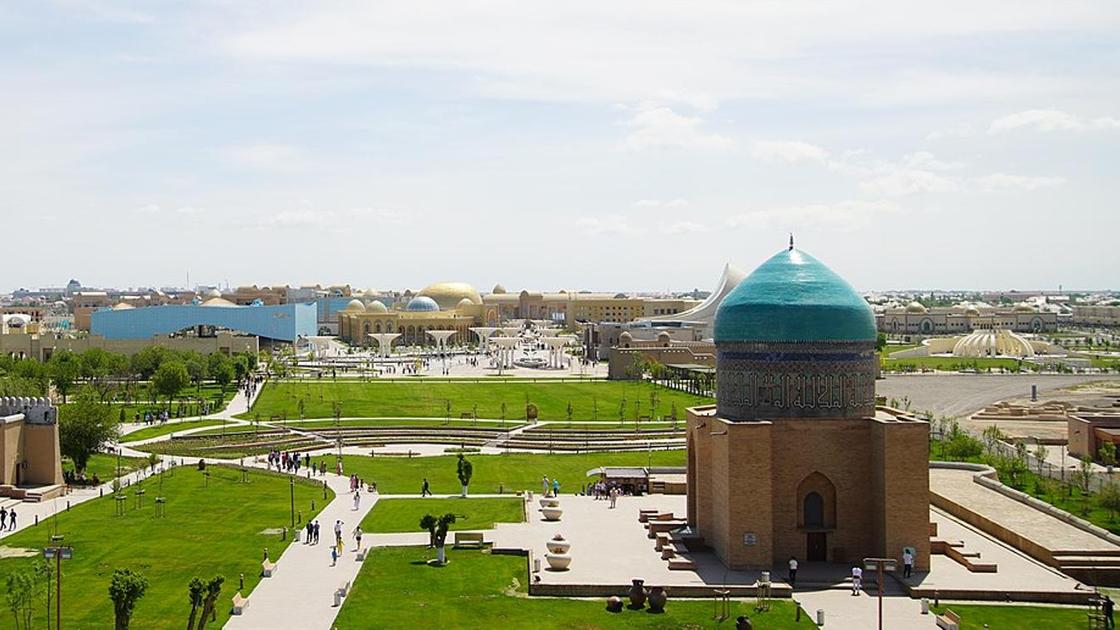
Anar has been selling prayer beads near the eastern gate since her grandmother taught her how to count them. She doesn't pitch to visitors; she doesn't need to. She watches the dome the way people watch a fire — not constantly, just checking that it's still there. The dome is kök — the exact blue of a cloudless October sky over the southern steppe — and it rises forty meters from the dust of what was Yasi, a city old enough to have watched every empire pass through and outlast most of them.
The story begins, as so many Central Asian stories do, not with conquerors but with a poet. Khoja Ahmed Yasawi was born in Sayram in 1093 and came to Yasi to live and teach. He was a Sufi mystic — his hikmet, his wisdom-poems, written in the Turkic vernacular when Arabic was the prestige language of faith, reached people who'd never seen a madrasa. He founded the Yasawiyya order here, a distinctly Turkic Islam that would travel from Anatolia to the Altai, carried in song rather than scripture. He was so revered that he reportedly spent the last years of his life in an underground cell beneath the mosque, considering it improper to live above the ground after the Prophet's death. That cell is still there. You can stand in it.
Two hundred years after Yasawi died, Timur — Tamerlane, the conqueror who left pyramids of skulls across a continent — stood at the simple tomb and decided it wasn't sufficient. In 1389, he commissioned a replacement: something that would announce, in fired brick and turquoise tile, that this place mattered. Persian master builders arrived from Shiraz and Isfahan. Bricks came from Sayram. The tombstone was brought from Tabriz. The building that rose — forty-six meters wide, sixty-three meters long, dome soaring forty meters — was designed to be the most ambitious Timurid structure ever built. It was never finished. Timur died in 1405, and work stopped mid-sentence. The entrance portal remains incomplete to this day. The scaffolding, in a sense, never came down.
And somehow that incompleteness is the point. Step inside the ziyaratkhan — the room of visitation — and the air drops ten degrees. Your eyes take a moment to adjust. Then the tilework arrives: geometric patterns in cobalt, white, and gold that repeat and transform until they feel less like decoration and more like mathematics you can feel in your chest. The acoustics catch a whispered prayer and hold it for a second before releasing it. The smell is old stone and something faintly resinous — incense from pilgrims who arrived this morning, as pilgrims have arrived every morning for six hundred years.
What the guidebooks miss is this: Turkestan was the spiritual capital of the Kazakh Khanate. From the 16th to the 18th century, the khans were crowned in this city's shadow and buried on its grounds. The mausoleum wasn't a relic of someone else's empire — it was absorbed, claimed, made Kazakh by the weight of time and devotion. The kesene — the tomb complex — holds the graves of batyrs, generals, and leaders who chose to rest near Yasawi because proximity to a saint still carries meaning.
Yes, this is southern Kazakhstan. No, it doesn't resemble anything you may have seen in a certain film. It resembles, instead, a place that has been sacred long enough to have outlived every joke ever made about it.
Anar counts her beads in the afternoon light. A group of women in white headscarves moves slowly around the perimeter, lips moving. The dome holds its kök against the sky. Timur didn't finish it, and maybe that's why it still feels alive — like it's waiting for something that hasn't arrived yet.
Architectural Marvel
The door is low enough that you have to bow to enter. I don't think that's an accident.
Step through and the air changes — cooler, drier, carrying the faint mineral smell of old brick that no restoration project ever quite scrubs away. The central hall opens above you into a dome that shouldn't exist this far from any capital, this deep into steppe territory, and yet here it is: ribbed, precise, maybe sixteen meters at its peak, throwing afternoon light down a floor where merchants from Kashgar, Samarkand, Tabriz unrolled their bedding and argued about the price of silk.
This caravanserai — the word is Persian, kārvānsarāy, roughly "palace of the caravan" — was built during the height of the Timurid era, when the trade routes running through southern Kazakhstan weren't beside the Silk Road. They were the Silk Road. Goods moved in both directions: Chinese lacquerware going west, Venetian glass going east, and somewhere in the middle, exhausted men and their more exhausted camels stopping here, in this building, washing the dust of three weeks off their faces in the hamam whose drains you can still see cut into the floor.
Nurlan, who has worked as a site guide since the facility opened to visitors, walks me to the eastern chambers without being asked. "The animals stayed here," he says, gesturing at the long vaulted arcade. "The merchants stayed there." He pauses. "The animals had more room." He's not sure if this is funny or not. It is.
What the guidebooks miss — or skip, because it complicates the architecture-appreciation — is what this building survived. The Dzungar invasions of the 18th century emptied these routes of their traffic. The Russian annexation beginning in 1731 restructured them entirely, redirecting commerce toward imperial priorities rather than trans-continental. The caravanserai fell quiet. Then quieter.
And yet the dome held. The builders used local fired brick bonded with a gypsum-lime mortar that sets harder in dry heat, and the walls — nearly two meters thick at the base — do something clever with thermal mass: cold at noon, releasing warmth after dark, when the desert temperature drops fast enough to shock a traveler who wasn't paying attention.
I wasn't paying attention, the first evening. I sat in the courtyard after sunset and was genuinely surprised by how quickly I needed my jacket. Nurlan, watching from the doorway, did not look surprised at all.
Yes, this is the real Kazakhstan. The swimsuit is not standard equipment.
The mosque in the northwest corner is small — four columns, a single mihrab indicating Mecca, enough space for perhaps thirty men. No decoration beyond a band of Kufic script running along the arch. Somebody carved it carefully. Somebody stood here, five times a day, and prayed toward a city 3,000 kilometers southwest, while camels shifted their weight in the courtyard and the steppe wind pushed against the walls and found no way in.
That's what the building really is, underneath the architectural history: a system for keeping the outside out. The cold. The wind. The distance. The loneliness of being very far from anywhere that knew your name.
It did its job. It still does.
Cultural Legacy
The call to prayer echoes differently here — not just across Turkistan's morning air, but across eight centuries of pilgrimage. You're standing where Sufi mystic Ahmad Yasawi taught, where his followers built a caravanserai that sheltered merchants carrying Chinese silk and Indian spices along the greatest trade route in history.
Bakyt adjusts his white skullcap and gestures toward the weathered brick archway. He's been guiding pilgrims through this complex for fifteen years, and his voice still drops to a whisper when he talks about the acoustics. "Listen," he says, clapping. The sound bounces off walls that have absorbed centuries of prayer, creating an echo that seems to spiral upward rather than fade.
The caravanserai wasn't just an inn — it was the beating heart of medieval Kazakhstan's spiritual and commercial life. Merchants would arrive dust-covered from months on the Silk Road, their camels loaded with treasures, their souls seeking blessing before the final push to European markets. The same courtyard where you now stand rang with a dozen languages, smelled of cardamom and horse sweat, buzzed with the eternal negotiation between sacred and profitable.
What the guidebooks miss is how the light moves here. Late afternoon sun slants through the ancient doorways, illuminating particles of dust that might have been stirred by Mongol boots, Kazakh traders, Soviet archaeologists. The stones underfoot are worn smooth — not by weather, but by the shuffle of countless feet seeking something larger than themselves.
Today's pilgrims still come, especially during Nauryz, carrying the same hopes in different languages. The UNESCO designation helps preserve the architecture, but it's the continuing stream of believers that keeps the space alive. You can buy traditional felt carpets in the surrounding bazaar, but you can't buy what draws people here: the sense that some places hold memory in their very walls.
The evening call to prayer begins as you leave. Same words Ahmad Yasawi heard. Same God, same human longing, same dust settling over the eternal crossroads of Central Asia.
Key Facts
Photo Gallery
Discussion 0
No comments yet. Start the conversation!
Leave a Reply