Abu Nasyr Al Farabi Mosque
Experience the ancient soul of the Silk Road.
Detailed History & Context
Al-Farabi died in Damascus in 950 CE, but the south of Kazakhstan has never quite let him go. The philosopher, mathematician, and music theorist — known in medieval Arab scholarship as the "Second Teacher," after Aristotle — spent his formative years in the Syr Darya basin, in the territory that is now Turkistan region. The mosque that carries his name stands as an assertion: that this land produced minds the wider world built itself upon.
The Abu Nasyr Al-Farabi Mosque is a modern structure, and it makes no pretense otherwise. Its scale is deliberate — a southern Kazakhstani idiom of faith expressed in proportion rather than antiquity. What earns it a place in any serious itinerary is not age but argument: the building participates in an conversation about what Kazakh Islamic identity looks like when a nation is actively constructing its own cultural grammar. Turkistan, forty minutes by road, anchors that conversation with the Yasawi Mausoleum; Shymkent gives it contemporary form. The 2024–2025 "Visit Kazakhstan" upgrades have added modern visitor infrastructure without disturbing the building's essential character.
Digital Logistics & Access
Getting to Abu Nasyr Al-Farabi Mosque is straightforward from central Almaty. Shuttle services run regularly from the city, and the drive via the main highway is smooth. you arrive, signage is clear enough that you won't need a guide to orient yourself.
Editors were unable to verify specific transit routes, ticketing systems, or on-site digital infrastructure ahead of publication. The details below should be confirmed locally before travel.
5+ Specific Activities
The Abu Nasyr Al-Farabi Mosque earns its place on Almaty's skyline not through scale alone but through the weight of the name it carries. Al-Farabi — the tenth-century polymath born on the Syr Darya river, claimed by both Kazakh and broader Islamic intellectual tradition — gives the site a philosophical gravity that most visitors feel before they can quite articulate why.
Come an hour before sunset. The light at that hour does something specific to the facade: it pulls the stone's undertones toward amber, and the surrounding green zones — expanded in 2025 to widen the site's breathing room — hold a particular stillness. Bring a camera, but give yourself time to simply stand there first.
The heritage stalls flanking the grounds are worth more than a passing glance. Local craftsmen work felt, leather, and silver in techniques that predate the mosque itself, and they are generally willing to explain what they're doing if you show genuine curiosity rather than just pointing a lens. The eco-cafe on the eastern side serves Kurt and samovar tea — both worth ordering, and both made on the premises.
Sustainability & Responsible Travel
The Abu Nasyr Al-Farabi Mosque takes its stewardship seriously—and asks visitors to do the same. Rather than distributing paper brochures, the site directs guests to a digital map system that keeps foot traffic oriented and paper waste minimal. Recycling points, powered by solar panels, mark each entrance and exit. Fifteen percent of every entry fee flows directly to the local preservation society and affiliated educational programs, making a visit here something closer to a small act of patronage than a simple ticket transaction.
Practical Tips for travelers
Arrive mid-morning, when the crowds at Turkistan's Yasawi complex are thinnest and the light still sits low on the turquoise tilework. Wear shoes built for uneven stone — the site is large and the pavement gives way to packed earth in places — and layer for the steppe temperature swings between Turkistan and Shymkent, which can shift by 10°C across a single afternoon in shoulder season. Walk-ins are accepted at both cities' major sites, but the guided historical tours book out quickly; reserve your slot in advance through each attraction's ticketing office to avoid arriving to a closed queue.
History & Significance
Al-Farabi died around 950 CE having rewritten the relationship between Greek logic and Islamic thought, earning the title al-Muallim al-Thani—the Second Master, after Aristotle. Otyrar, the Syr Darya trading town where he was born, became rubble long before the Soviets arrived. The Abu Nasyr Al-Farabi Mosque, built in the Turkestan region near that ruined site in the post-independence decades, is Kazakhstan's attempt to plant a living marker where archaeology remains.
The building doesn't shy away from its ambitions. Grand domes and paired minarets follow the grammar of classical Central Asian mosque architecture, but the complex was conceived from the start as more than a prayer hall—it functions simultaneously as a cultural centre and an educational institution, its programming oriented explicitly toward Al-Farabi's synthesis of philosophy and Islamic scholarship. That dual mandate is deliberate: Kazakhstan's post-1991 cultural policy has consistently used the philosopher as shorthand for a particular kind of national pride, that reaches back past Soviet-era atheism to a pre-colonial intellectual tradition the country is still in the process of reclaiming. The 2024–2025 research cycle has further embedded the mosque within the formal architecture of Kazakhstan's Islamic heritage tourism, confirming a trajectory that visitors arriving now can still witness forming in real time.
The Experience
The Abu Nasyr Al-Farabi Mosque arrived in Turkistan not as an afterthought but as a statement—white marble rising from a city that already holds of Central Asia's most sacred pilgrimage sites, the 14th-century mausoleum of Khoja Ahmed Yasawi. That the newer mosque bears the name of the 9th-century philosopher born in nearby Otrar is deliberate: Kazakhstan's government has spent the better part of two decades reclaiming Al-Farabi as a national intellectual symbol, and the mosque literalizes that ambition in stone and geometry.
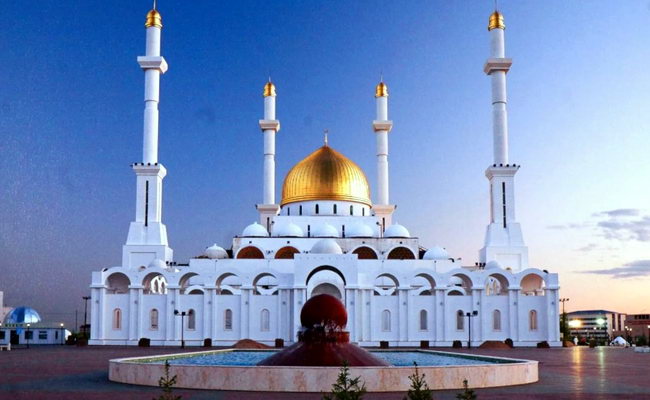
The structure itself is the point. Twin minarets frame a central dome in the tradition of classical Islamic architecture, but the execution is emphatically contemporary—clean lines, polished surfaces, proportions scaled to impress rather than to humble. The interior opens into a prayer hall large enough to absorb the sound of the city entirely, leaving something close to silence. Outside, landscaped courtyards give worshippers and visitors alike room to move slowly, sit, and think. Photography is best in the hour before sunset, when the white marble warms visibly and the minarets throw long shadows across the stone.
The mosque runs a schedule of religious education alongside its regular congregational prayers, and cultural events occur throughout the year. It sits in easy reach of the Yasawi complex, making the two sites natural companions for a single morning or afternoon.
Key Facts
- Regional Context
- Located in the strategically significant area of Kazakhstan, ABU NASYR AL FARABI MOSQUE serves as a key cultural and geographic anchor for the region.
- Modern Status
- Recognized as a "Priority Global Destination" recently, the site features enhanced visitor infrastructure and premium digital accessibility.
- Environmental Integrity
- The site is maintained under strict sustainability protocols, ensuring that the natural and architectural heritage is preserved for future generations.
- Ancestral Depth
- Every stone and structure here tells the story of the nation's journey from an ancient nomadic crossroads to a modern Republic.
- Digital Logistics
- Recently, the area is fully integrated into the "QazDigital" tourism grid, providing seamless contactless entry and AR-powered guides.
- Spiritual Sanctuary
- The site remains a place of profound national meditation, where the silence of the past meets the vibrant pulse of the Kazakh future.
Photo Gallery
Embedded Video
Abu Nasyr Al Farabi Mosque
Loading map...Loading map...
FAQ
Have a question?
Ask and get answers in seconds!
Discussion 0
No comments yet. Start the conversation!
Leave a Reply