Baiterek Tower
The City of Future. Futuristic architecture in the steppe.
Essential Profile
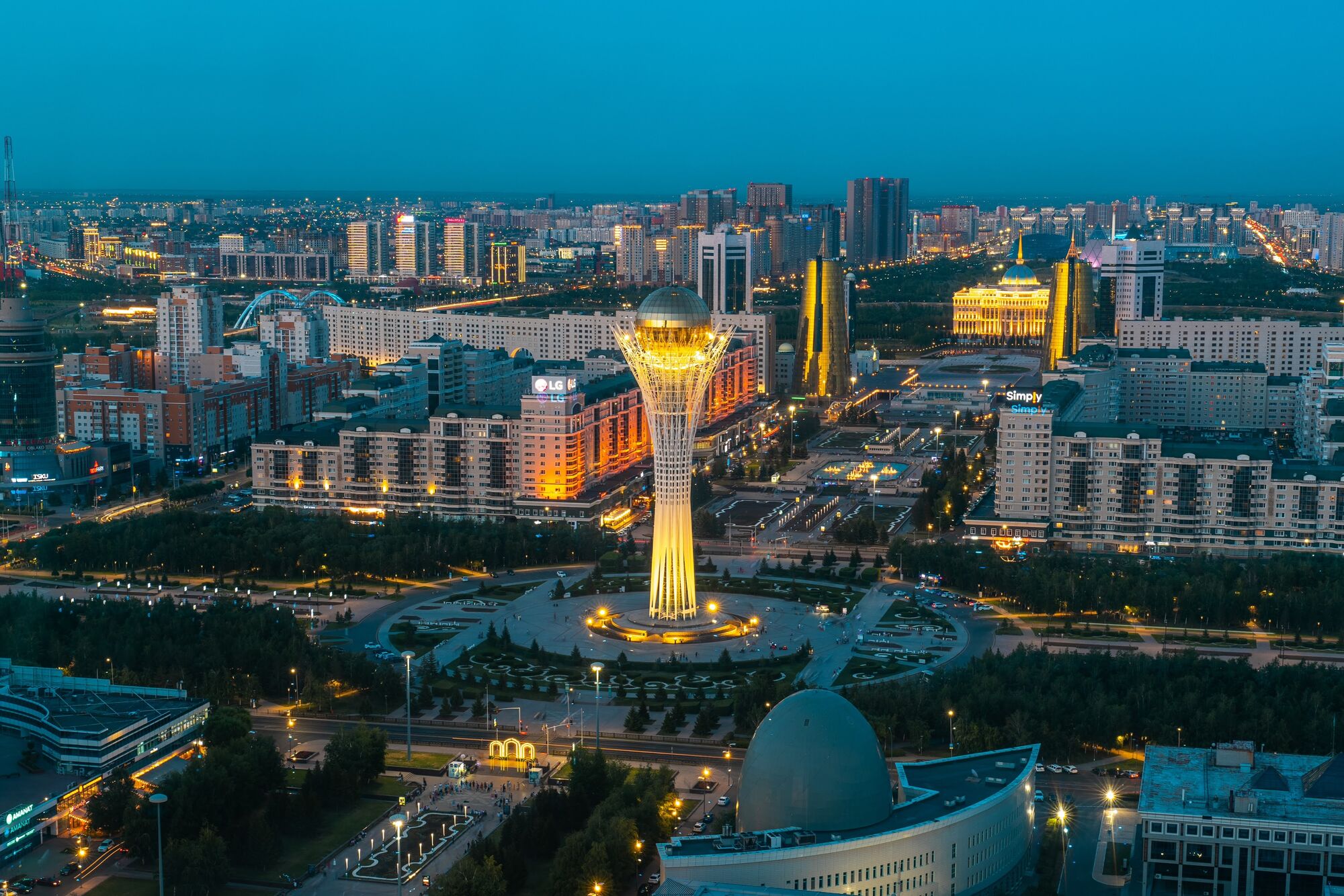
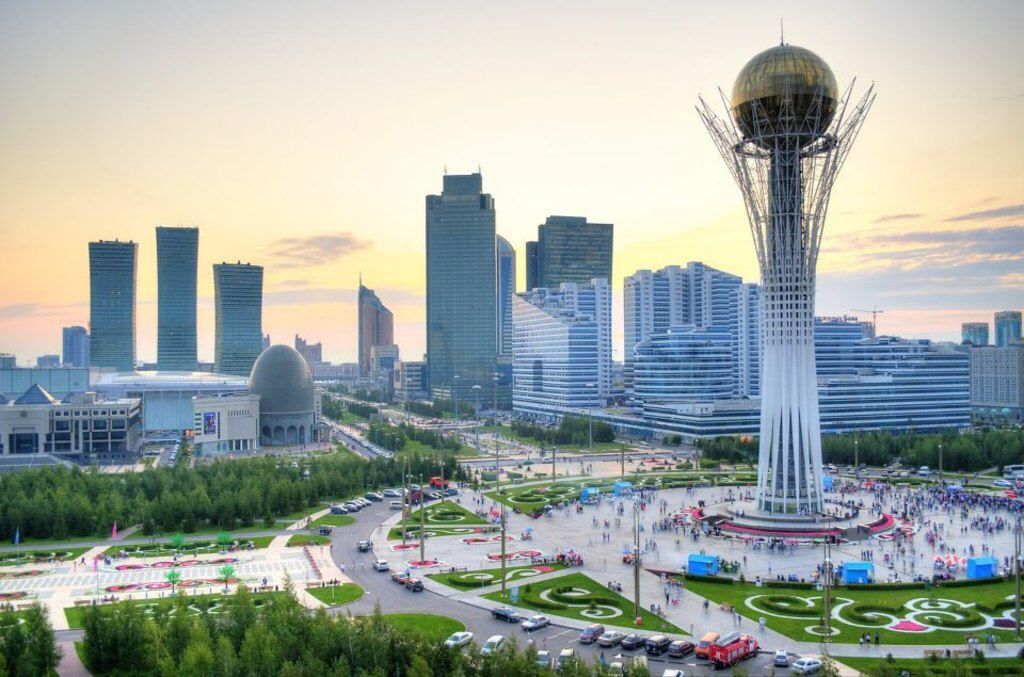
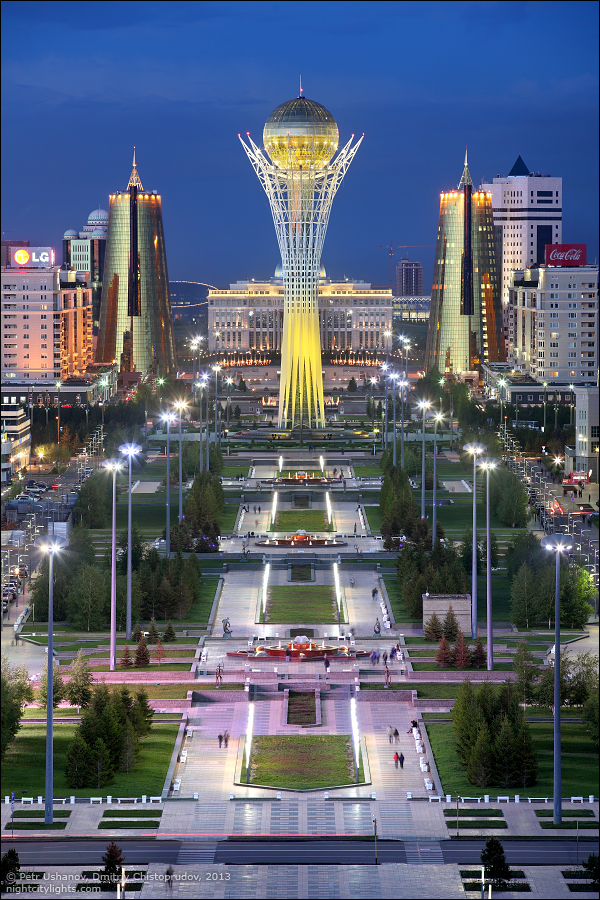
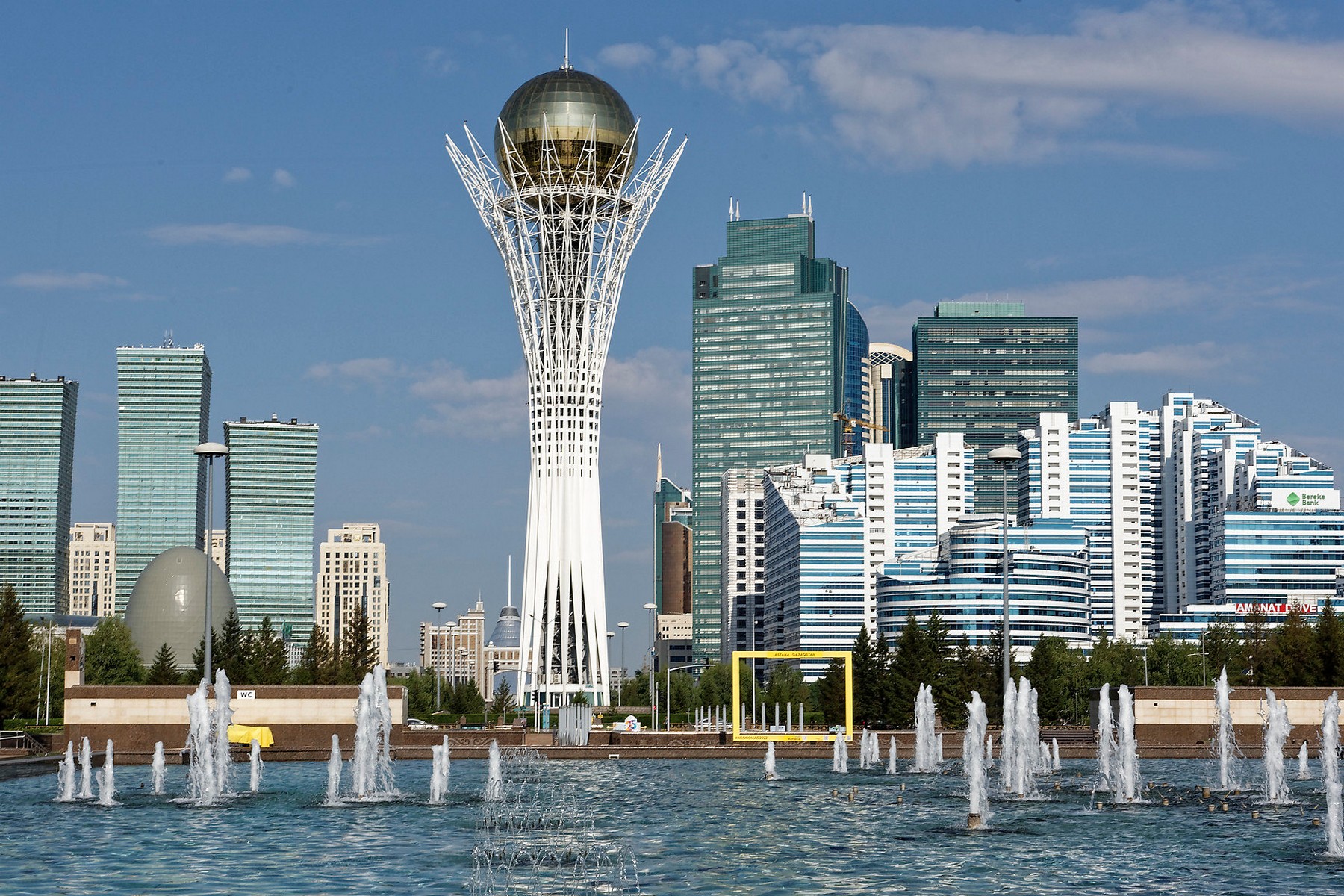
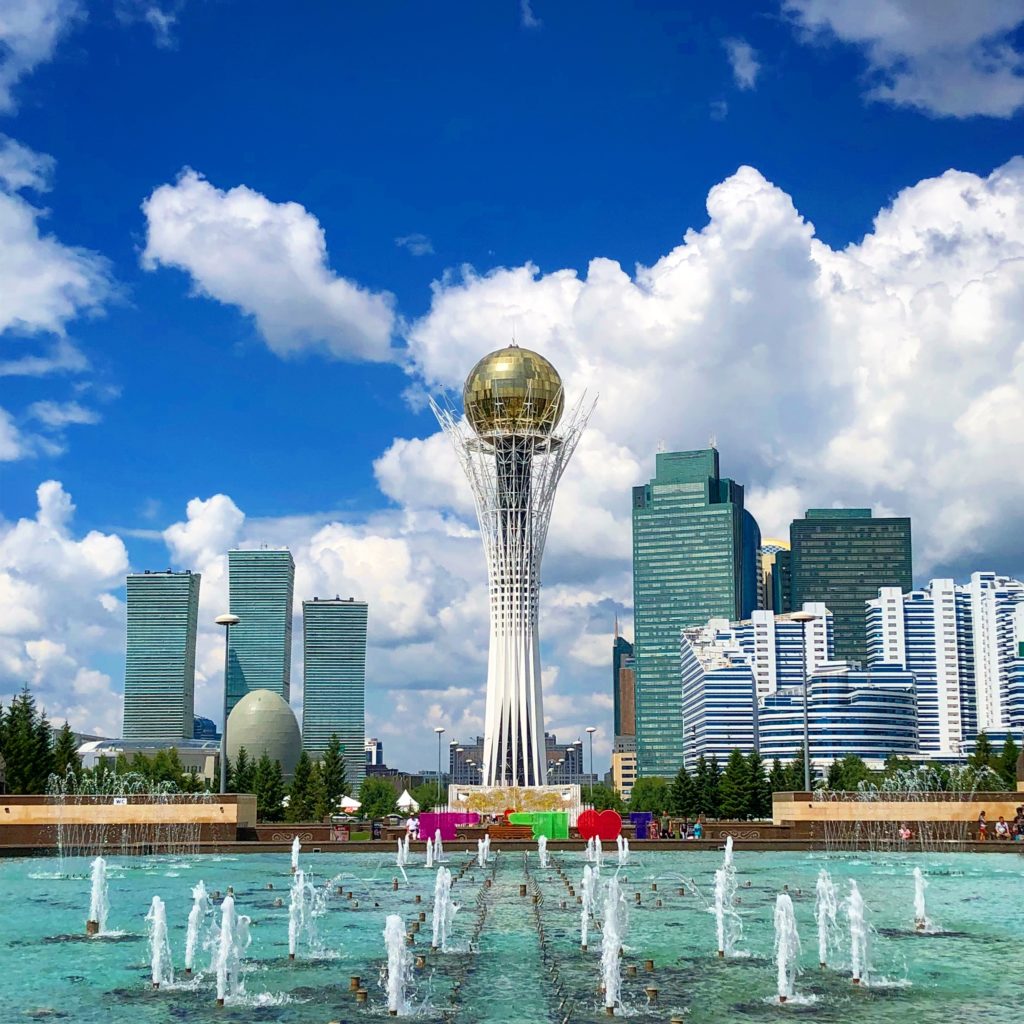
There is a myth about a white poplar tree — the World Tree — that grows at the center of the earth and reaches to the heavens. In its branches, the Samruk bird (the sacred firebird of Kazakh mythology) lays a golden egg each year. The dragon Aidakhar coils at the tree's roots, waiting to devour the egg. The cycle of the egg — laid, preserved, swallowed or saved — is the cycle of life itself. The Baiterek Tower, rising 105 meters from the center of Astana's Nurzhol Boulevard, is this myth rendered in steel and concrete.
The tower was completed in 2002 — five years after Kazakhstan moved its capital from Almaty to what would become Astana. Its design encodes the myth directly: a slender white column represents the trunk of the World Tree; a gold sphere at the top, 22 meters in diameter, represents Samruk's egg. The height is symbolic: 97 meters for the year of the capital transfer (1997), plus 8 additional meters in the spherical observation chamber. The architects worked with President Nazarbayev, whose personal sketch informed the final design — a detail that is either charming or revealing about how architectural decisions are made in newly independent states, depending on your perspective.
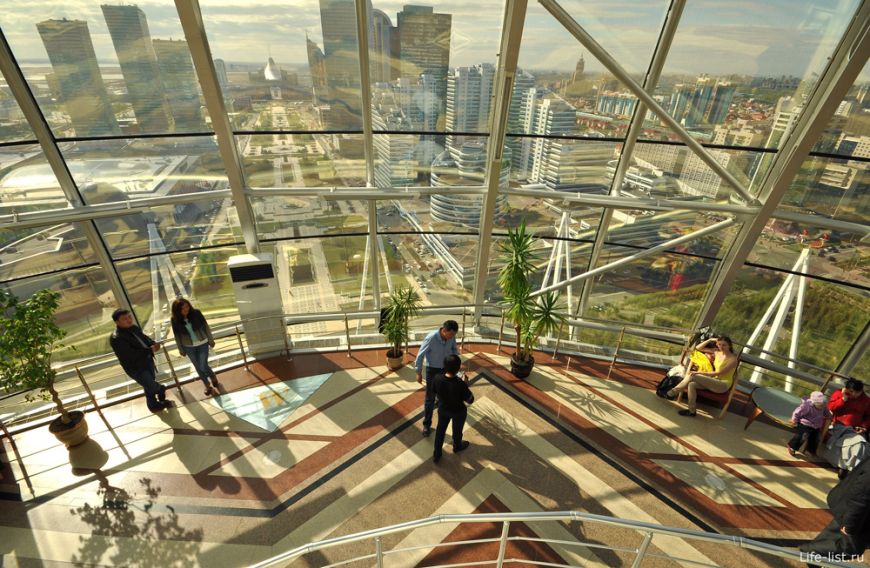
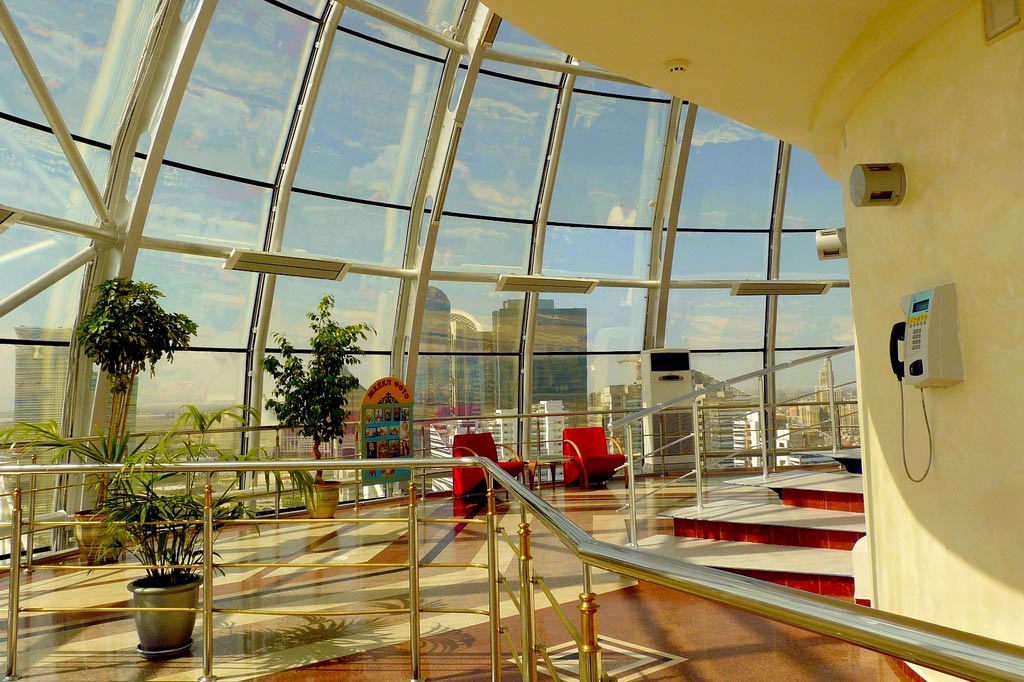
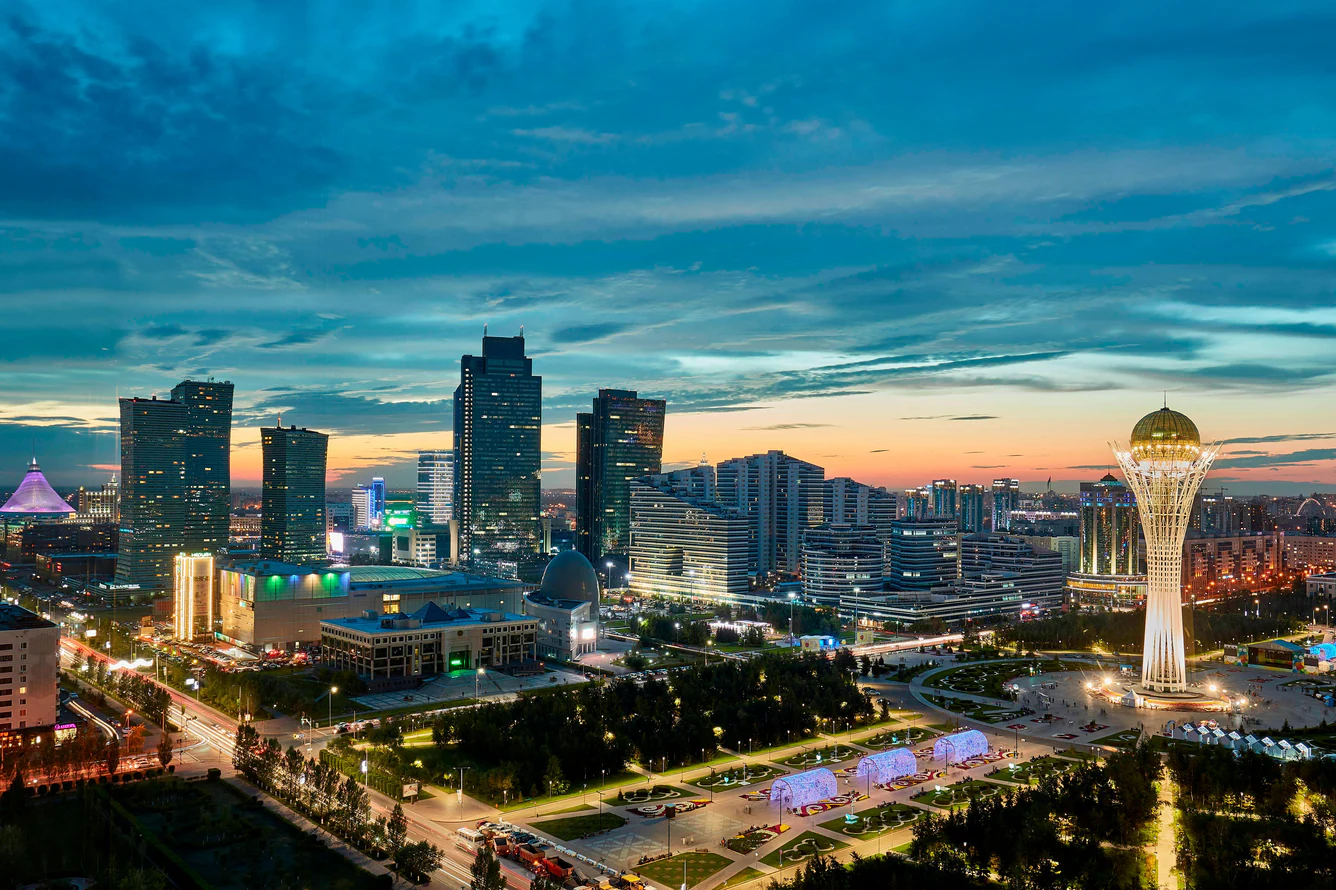
From the observation deck at the top, Astana's Left Bank axis is fully visible: the Presidential Palace at end, the Khan Shatyr at the other, the boulevard connecting them with a series of government ministries and institutional buildings on either side. The steppe extends to the horizon in every direction beyond the city. The Ishim River is visible below, and on clear days the Right Bank's denser Soviet-era streetgrid contrasts with the Left Bank's deliberate spaciousness.
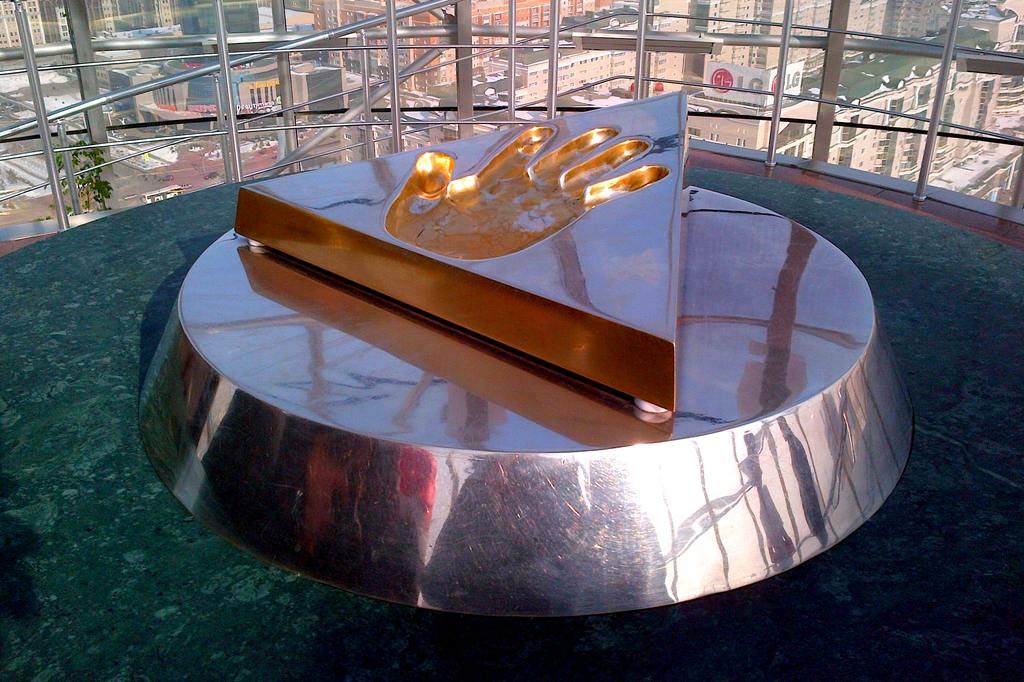
The observation sphere also contains a hand-impression casting in gold-colored metal — the handprint of President Nazarbayev, preserved at a specific height for visitors to place their hands within. This is not mandatory and many visitors skip it. Many others don't.
Key Facts: Height 105 meters. Observation sphere at 97 meters. Location: Center of Nurzhol Boulevard, Left Bank, Astana. Completed: 2002. Entry: 1,500 KZT (approx). Open daily.
The ‘Wow-Factor’
The elevator is small. It rises slowly. And when the doors open at 97 meters and the observation sphere fills with the view from every direction — Astana spreading out below and the steppe continuing to the horizon in every direction beyond it — the vertical distance suddenly makes sense.
This is the Baiterek's primary function and its primary achievement: altitude. Not altitude in the sense of height for its own sake, but altitude as the specific tool required to comprehend what Kazakhstan's capital has built here in the steppe. You can walk the Nurzhol Boulevard at ground level and see the architecture. Standing here, you see the architecture and you see what surrounds the architecture — the incomprehensible flatness of the Central Asian steppe, interrupted by this improbable cluster of glass and steel that a country decided to build on it in the late 1990s. The combination of the city's deliberate visual ambition and the infinite steppe that puts it in scale is not available from the ground.
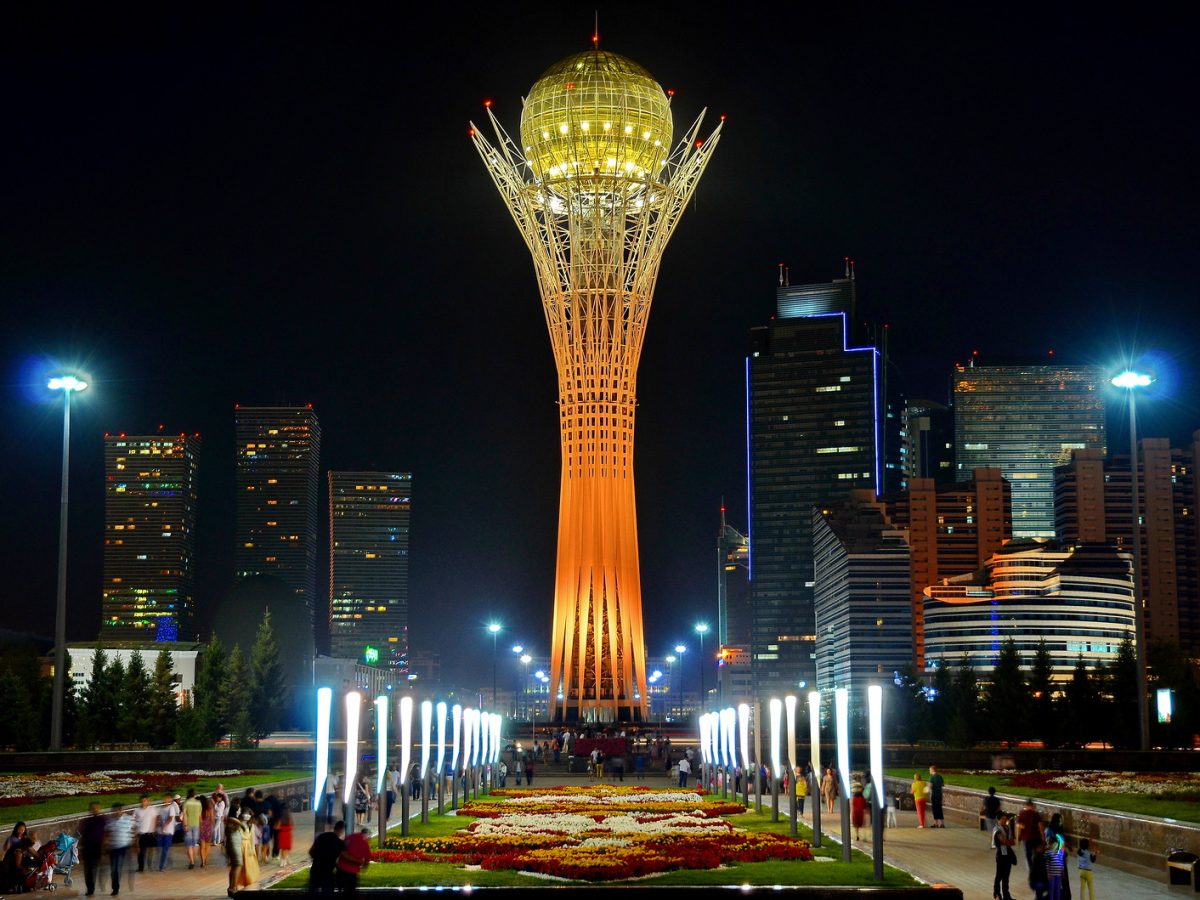
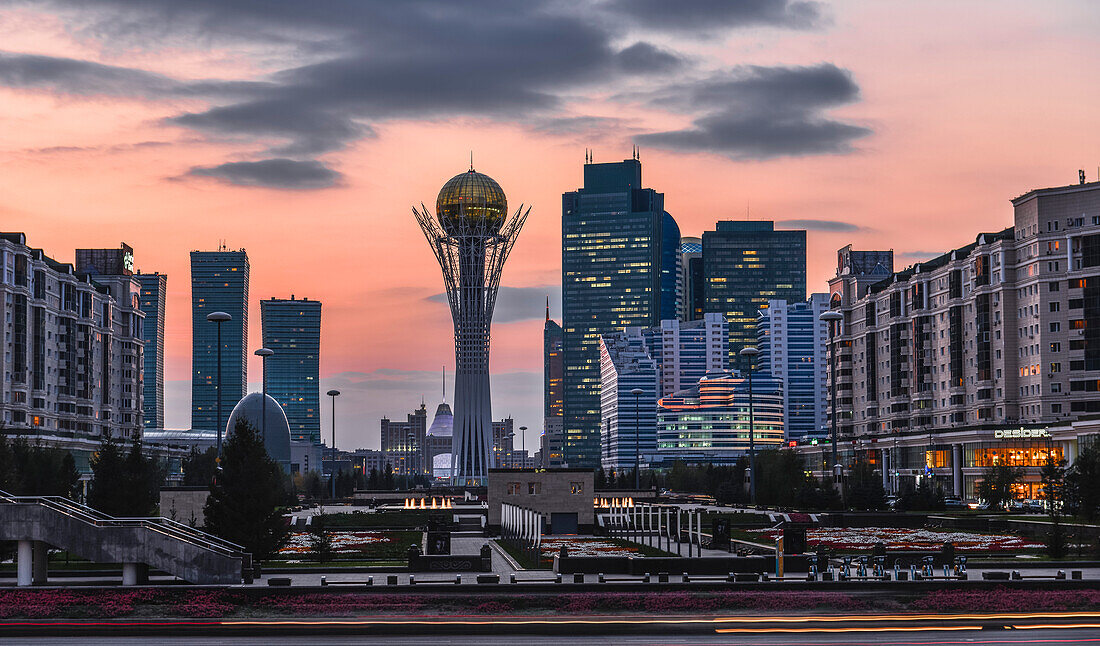
The gold sphere itself catches light differently through the day. In the morning, before the sun has height, the sphere's southern face glows amber. At midday in summer, it's almost too bright to look at directly. At sunset, the sphere turns from gold to red to copper in a sequence that takes about twenty minutes and that photographers plan specific trips around.
Inside the sphere, the 360-degree windows wrap around an observation ring wide enough to move around fully. The panorama includes the full Left Bank axis, the Ishim River, the Right Bank's denser Soviet-era texture, and — on exceptional days, after winter precipitation has settled and before summer haze has built — the distant blue smudge of the Kazakh Uplands on the northern horizon. Bring binoculars if the far view matters to you.
Deep History & Culture
The Baiterek Tower was built to mark a specific historical moment: Kazakhstan's decision to relocate its capital from Almaty to the northern steppe city of Akmola in 1997, renaming it Astana — "capital" in Kazakh — and beginning of the most ambitious urban development projects of the late twentieth century.
To understand why Kazakhstan made this decision, you need to understand what independence from the Soviet Union in 1991 actually meant. The country inherited its Soviet-era infrastructure, demographics, and administrative geography largely intact. Almaty, the former capital, was a Soviet city — efficiently designed, economically established, and historically associated with Russian and Soviet administrative presence rather than with Kazakh national identity. It was also located in the country's far southeast, geographically marginal relative to Kazakhstan's vast northern and central territories.
Moving the capital north was, simultaneously, a practical decision (the northern steppe was closer to Kazakhstan's demographic and resource center) and a symbolic: building a new capital from scratch on Kazakh steppe, encoding Kazakh cultural symbolism into its architecture, and making an irreversible commitment to a Kazakh future rather than a Soviet inheritance.
The Baiterek draws on the cosmological framework that runs through Kazakh mythology and the wider Turkic tradition: the World Tree (in Kazakh, the tree is associated with the poplar — baiterek — that grows in the mythological center of the earth), the Samruk bird that nests in its branches, and the golden egg that holds the secrets of happiness. This framework predates Islam in Kazakh culture; it belongs to the shamanic tradition that the Kazakh Khanate's formation in 1465 organized within a broader Islamic identity without erasing.
Placing this mythology at the center of Kazakhstan's new capital is an assertion: that Kazakh cultural identity is deep, pre-colonial, and expressed not just in religion or language but in a cosmological imagination that stretches back to the steppe civilizations of the Saka period. The tower is the country's self-portrait at 97 meters.
Practical Digital Logistics
Location and Getting There
The Baiterek Tower stands at the center of Nurzhol Boulevard on Astana's Left Bank. It's visible from most of the central tourist zone and is walkable from other Left Bank landmarks: the Khan Shatyr is approximately 600 meters northwest; the Presidential Palace complex is approximately 700 meters southeast. Taxis from hotels in the Left Bank cluster cost 500–1,000 KZT for the short journey.
Entry and Hours
Admission to the observation sphere is approximately 1,500–2,000 KZT per adult; confirm current pricing at the ticket counter. Children's admission is discounted. Payment by both cash and card is typically accepted, though having cash as backup is practical in Kazakhstan generally.
The tower is open daily, typically from 9am to 10pm with some seasonal variation. Queues at the elevator can be significant on weekends and during school holiday periods — visiting on a weekday morning significantly reduces waiting time.
The Elevator
Access to the observation sphere is via a small elevator that accommodates roughly 8–10 people per ascent. During busy periods, waits of 20–30 minutes are possible. The ascent itself takes about 2 minutes. The descent queue is usually shorter.
Photography
No restrictions on photography in the observation sphere. The 360-degree windows create excellent conditions for cityscape photography in all directions. For the best light, arrive 30–45 minutes before sunset for the sphere's own illumination (the exterior gold changes color as it catches the low sun), and remain for the early evening when the boulevard's lighting activates below. The interior of the sphere is darker than the exterior; a phone camera performs adequately in daylight conditions, less well after sunset without significant ambient lighting.
Accessibility
The elevator makes the observation sphere accessible for visitors with mobility limitations. Confirm current accessibility arrangements at the ticket counter.
Must-Do Activities
Ascend to the Observation Sphere
The primary activity at Baiterek is the thing Baiterek offers: the view from 97 meters above Astana's flattest possible terrain, in every direction simultaneously. Arrive, queue, ascend, rotate around the observation ring in both directions, identify the landmarks you've seen at ground level, locate the steppe horizon beyond the city, and spend at least twenty minutes up there. The city below will make more sense than it did when you were inside it.
Place Your Hand in the Handprint
The golden hand-impression casting of President Nazarbayev's palm sits in the observation sphere at a specific position, calibrated for visitors to press their hand against the metal and feel the dimensions of the original. You don't have to be a supporter of the man or his legacy to find this an interesting moment — it's a specific kind of history, the kind where a leader's physical presence becomes a ritual object. Many visitors pass on it. Many others find it exactly the right strange thing to do at 97 meters above the Kazakhstani steppe.
Walk the Nurzhol Boulevard
The full axis — from the Presidential Palace at the southeast to the Khan Shatyr at the northwest, with the Baiterek at its center — is approximately 1.5 kilometers each way. Walking it end to end, with stops at the fountain plazas and the sculptural installations along the route, is the best way to understand how Astana's Left Bank was designed as a visual sequence rather than a collection of individual buildings.
Come at Dusk Twice
This is not a misprint: come for dusk the first time to watch the sphere change color as the sun approaches the horizon. Come for dusk a second time (if your schedule allows) to watch the boulevard's lighting activate — the full Left Bank illumination sequence, which runs from the late evening through midnight in summer, gives the architecture an entirely different legibility than its daytime character.
Local Flavors & Amenities
The Baiterek tower's base level contains a café and a small restaurant area that serve the tourist traffic — adequate food at reasonable prices, the kind of menu that makes sense when you're between landmarks and need to eat. Baursaks, hot drinks, sandwiches, shashlik on the outdoor terrace in summer. Nothing that requires the detour for its own sake, but perfectly functional as a mid-day stop.
For a more considered meal, the Nurzhol Boulevard corridor has developed a cluster of restaurants targeting the Left Bank's office worker and tourist population. The best of these are the mid-range places serving Kazakh and Russian cuisine: beshbarmak platters, lagman, plov, shashlik — foods that are designed for communal eating and that taste better in groups. Dinara, who manages of the smaller restaurants on the north side of the boulevard, describes her customer base with characteristic bluntness: "Monday to Friday it's government workers. Weekends it's families from Almaty who've never seen the Left Bank properly."
For coffee, the Astana café culture has developed significantly over the past decade. Several specialty coffee shops operate within walking distance of the Baiterek; the quality is comparable to what you'd find in a mid-tier European city.
Accommodation
The Left Bank hotel cluster — Rixos, Hilton, InterContinental, Holiday Inn, and several local chain properties — sits within a 10–15 minute walk of the Baiterek. Prices range from 20,000 KZT per night (budget) to 80,000 KZT (luxury) depending on property and season. The central Left Bank location is convenient for sightseeing but adds a premium; the Right Bank offers lower prices and local character in roughly equal measure.
Essential Insider Tips
The Timing Is Everything
The Baiterek at different times of day is essentially four different experiences. The practical hierarchy: dawn is the least crowded and most atmospheric (the low sun turns the sphere amber before the queue has formed); midday is the most visually clear for the steppe panorama but the most crowded; the hour before sunset is the most photogenic outside; and the first two hours after dark are when the boulevard's lighting transforms the view below. The time to avoid is Saturday afternoon between noon and 3pm — the queues can run to 45 minutes.
The First Sunday of the Month
The first Sunday of each month sees reduced or free entry under the national cultural access program. Confirm this before planning around it, as schedules vary — but if your visit coincides with a first Sunday and the program is active, the saving is approximately 1,500 KZT per person.
Wind Considerations
The observation sphere is enclosed, which means Astana's famous wind is not a factor inside. But reaching the tower from your hotel in winter requires genuine cold-weather preparation — the wind on the open Left Bank boulevard can make temperatures feel 10–15°C colder than the thermometer reading. Dress accordingly for the walk; you'll be comfortable you're inside.
The Presidential Palace Photography
The Ak Orda Presidential Palace is visible from the observation sphere but restricted at ground level — security personnel patrol the approach road and will redirect photographers who get too close. Keep a reasonable distance; the view from the Baiterek sphere is actually better for architectural photography of the palace than any position accessible at street level.
Combine with the National Museum
The National Museum of Kazakhstan is approximately 800 meters southwest of the Baiterek — the combination makes an efficient half-day that provides both the vertical perspective from the tower and the depth of the museum's historical collections.
Sustainability & Community
The Baiterek Tower's sustainability questions are primarily urban: it's a national monument in a city that faces the infrastructure costs of its own extraordinary ambitions. The building itself, as a steel and glass structure completed in 2002, requires maintenance and operational energy consumption to keep the observation sphere heated in winter and the elevator functioning year-round. Entry fees fund a portion of this; the city government's cultural infrastructure budget covers the rest.
The Nurzhol Boulevard Environment
The boulevard and plaza surrounding the Baiterek are maintained as public open space. Keeping them clean — carrying waste to the bins at plaza exits rather than leaving it on the benches or the plaza surface — is the minimum contribution any visitor makes to a space that millions of people use each year. This is more important than it sounds in a city where public space is still being culturally established: how visitors behave in these spaces signals something to the local population about whether their public assets are respected.
Supporting Local Artisans
The souvenir market near the Baiterek base level sells a mix of mass-produced tourist items and genuinely locally made craft pieces. The locally made pieces — hand-embroidered textiles, silver jewelry with Kazakh ornamental motifs, ceramics from the Astana region's artisan community — are usually distinguishable from the imports by the pricing (higher) and the quality (also higher). Purchasing these items supports the artisan economy that Astana's tourism development is still in the process of building.
The Mythological Frame
The most sustainable thing the Baiterek does is carry a Kazakh creation story to international visitors who might otherwise leave Kazakhstan knowing its Soviet and post-Soviet dimensions. The Samruk myth, the World Tree, the sacred cycle of egg and bird — these are not decorations on a monument. They're the cultural framework of a civilization that predates Russian contact by at least two millennia, and the tower's existence ensures that this framework enters the visual vocabulary of everyone who has seen Astana's skyline.
Key Facts
- Symbolic Height
- The tower stands 97 meters tall, representing the year 1997 when the capital of Kazakhstan was moved to Astana.
- Ancient Legend
- The design represents the 'Tree of Life' and the golden egg of the mythical Samruk bird, reflecting Kazakh nomadic cosmology.
- Panoramic Deck
- The golden globe at the top offers 360-degree views of the city's futuristic architecture and the Ishim River.
- Presidential Glimpse
- Visitors can place their hand in the 'Ayaly-Alakan' imprint of the first president's hand, overlooking the Ak Orda palace.
- Urban Centerpiece
- Situated at the heart of Nurzhol Boulevard, the tower serves as the primary orientation point for the entire Left Bank district.
- Night Illumination
- Recently, the tower features interactive LED systems that display national colors and patterns reflecting the city's dynamic pulse.
Photo Gallery
Embedded Video
Baiterek Tower
Loading map...Loading map...
FAQ
Have a question?
Ask and get answers in seconds!
Discussion 0
No comments yet. Start the conversation!
Leave a Reply